Saltwater Pool Maintenance: Complete Guide
Everything saltwater pool owners need: salt levels, cell cleaning, chemistry targets, and cost comparison vs chlorine.
Saltwater Pool Maintenance: Complete Owner’s Guide
Saltwater pools still use chlorine. The difference is your pool makes it automatically. A salt chlorine generator (SWG) converts dissolved salt (NaCl) into free chlorine through electrolysis, so you never buy chlorine tablets again. But three things change from chlorine pool maintenance: your CYA target rises to 60-90 ppm, your pH climbs 0.2-0.4 per week on its own, and you have a salt cell to inspect and clean every 30-90 days. That is the real scope of saltwater pool maintenance, and this guide will point you to the right resource for each task. We reviewed the maintenance requirements across major SWG brands and found the checklist below covers everything that changes. For an introduction to general pool care, see our pool maintenance for beginners guide before diving in here.
Video guide
Video: “Salt Water Pool Maintenance for Beginners” by Swim University
Is This Guide for You?
This guide IS for you if:
- You have a saltwater pool and want to understand the full maintenance picture
- You are comparing saltwater vs chlorine before buying or converting
- Your “check cell” light just came on and you are not sure what to do next
This guide is NOT for you if:
- You specifically want to clean your salt cell right now — go to our guide on how to clean your salt cell
- You need salt level testing and dosing help — go to pool salt level
- You are troubleshooting a specific malfunction — go to saltwater pool problems
- You want to convert a chlorine pool to saltwater — go to how to convert pool to saltwater
How Saltwater Pools Actually Work
A saltwater pool is still a chlorine pool. The salt chlorine generator converts dissolved salt into free chlorine through electrolysis. Your test kit will still show free chlorine readings, and you still manage pH, alkalinity, calcium hardness, and CYA — the same parameters as any chlorine pool.
Ocean water sits at approximately 35,000 ppm salt. Your saltwater pool runs at 3,200 ppm, about one-tenth the concentration. At that level, most swimmers cannot detect any saltiness. The SWG operates within a range of 2,700-3,400 ppm. Below 2,700 ppm the unit underproduces or shuts off; above 3,600 ppm it becomes corrosive to equipment.
For a full explanation of how the equipment works, including the electrolysis chemistry, brand comparisons, and model specs, see our salt chlorine generator guide.
The saltwater maintenance checklist
| Frequency | Task | Different from Chlorine Pool? |
|---|---|---|
| Weekly | Test free chlorine, pH | pH rises faster — test pH twice per week |
| Weekly | Test salt level | New task — no chlorine pool equivalent |
| Monthly | Check SWG output percentage | New task |
| Every 30-90 days | Inspect salt cell for scale | New task |
| Every 3 months | Clean salt cell if scale is present | New task |
| Annually | Top up salt (25-50 lbs per 10,000 gal) | New task |
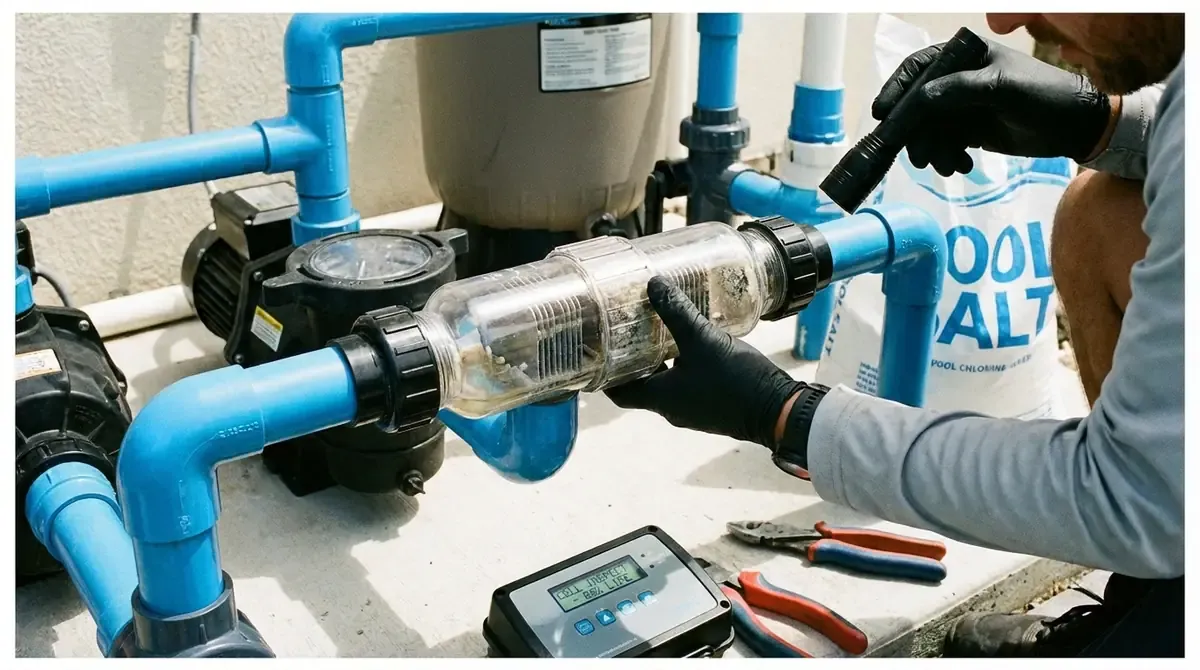
The cell inspection schedule depends on your water hardness. Hard water areas may need inspection every 30 days. Soft water areas can often stretch to 90 days. Do not wait for the warning light — by the time it activates, output has already dropped. For a step-by-step walkthrough of the inspection and cleaning process, see our guide on how to clean your salt cell.
For salt level testing and dosing, see pool salt level.
What Changes About Pool Chemistry in a Saltwater Pool
Saltwater pools share most chemistry targets with chlorine pools, but two parameters shift:
CYA rises to 60-90 ppm. Standard chlorine pools target 30-50 ppm. SWGs produce unstabilized chlorine around the clock, which is more vulnerable to UV degradation. The higher CYA acts as a sunscreen for that chlorine. If CYA climbs above 90 ppm, partially drain and refill the pool.
pH climbs 0.2-0.4 per week. Electrolysis generates hydrogen gas as a byproduct, and that raises pH consistently. You will need to add muriatic acid more often than you did with a chlorine pool. This is normal, not a malfunction.
Calcium hardness stays at 200-400 ppm — the same as any pool. Low calcium combined with salt creates a corrosive mix that attacks metal components.
For full targets, dosing amounts, and adjustment procedures, see our saltwater pool chemistry guide. For the fundamentals that apply to all pools, see pool water chemistry basics.
We also recommend checking NSF pool water standards{:target=“_blank”} and the EPA pool water safety guidelines{:target=“_blank”} for regulatory context on water quality parameters.
Saltwater vs. chlorine: is the switch worth it?
The short answer is yes — for most homeowners who plan to own the pool more than five years.
We found that annual chemical costs for a saltwater pool typically run $110-$230 per year, including salt ($10-$30) and amortized cell replacement ($50-$100/year). A manually dosed chlorine pool costs $300-$600 per year. That is a savings of $150-$400 annually once you account for the cell.
The upfront cost is higher: $500-$2,500 for the SWG unit, plus $50-$150 in initial salt. The cell itself costs $200-$700 to replace every 3-7 years.
For the full 10-year cost math with break-even analysis, see our saltwater vs chlorine pool cost comparison.
Common saltwater pool problems
The most common first-year issue is the “check cell” light. We consistently find this indicates the cell needs inspection, not necessarily replacement. Calcium scale on the plates reduces output, and a cleaning usually resolves it.
Green water despite the salt system running usually points to one of three causes: salt level below 2,700 ppm, a dirty or scaled cell, or a chemistry imbalance (especially CYA too low to protect chlorine from UV). Test all three before assuming equipment failure.
pH creeping high each week is the SWG working normally, not a malfunction. Plan for muriatic acid additions every 1-2 weeks during swim season.
For full diagnosis and repair steps, see our saltwater pool problems guide.
Saltwater pool FAQ
Do I still need to add chlorine to a saltwater pool?
No — but only because your salt cell produces it automatically. Saltwater pools still contain chlorine. Your salt cell converts dissolved salt into free chlorine through electrolysis. You are not eliminating chlorine; you are automating its production. Your test kit will still show free chlorine readings, and you still manage all the same chemistry parameters.
How often do I need to add salt?
Salt does not evaporate. Losses only occur through splash-out, backwashing, or heavy rain dilution. In most pools, expect to add 25-50 lbs of pool-grade salt per 10,000 gallons annually. New pools or freshly converted pools need a full startup dose to reach 3,200 ppm.
How long do salt cells last?
Salt cells last 3-7 years with proper care. The biggest factor reducing lifespan is aggressive acid cleaning. Always try a plain water soak first. Replacement cells cost $200-$700 depending on brand. When amortized over 5 years, that works out to $50-$100 per year — already factored into the cost comparison above.
Are saltwater pools safe for kids and pets?
Yes. At 3,200 ppm, saltwater pools feel noticeably softer than chlorine pools but are not harmful. The chlorine level is the same as any maintained pool: 1-3 ppm free chlorine. The reduced chloramine byproducts (the source of that harsh chlorine smell and eye irritation) make saltwater pools more comfortable for extended swimming.
Can I convert my existing pool to saltwater?
Most pools can be converted. The process involves installing an SWG inline with your return line and adding salt to reach 3,200 ppm. See our guide on how to convert pool to saltwater for the full step-by-step process, compatibility checks, and cost estimates. For more information on safe pool water practices, see the TroubleFreePool saltwater chemistry forum{:target=“_blank”}.