Saltwater Pool Chemistry: What’s Different and What Stays the Same
Saltwater pool chemistry uses the same parameters as a standard chlorine pool: pH, total alkalinity, calcium hardness, CYA, and free chlorine. But three things behave differently once a salt chlorine generator (SWG) enters the picture. CYA targets are higher, pH rises faster and more predictably, and muriatic acid becomes a regular addition rather than an occasional one. The underlying chemistry is identical; only the management rhythm changes.
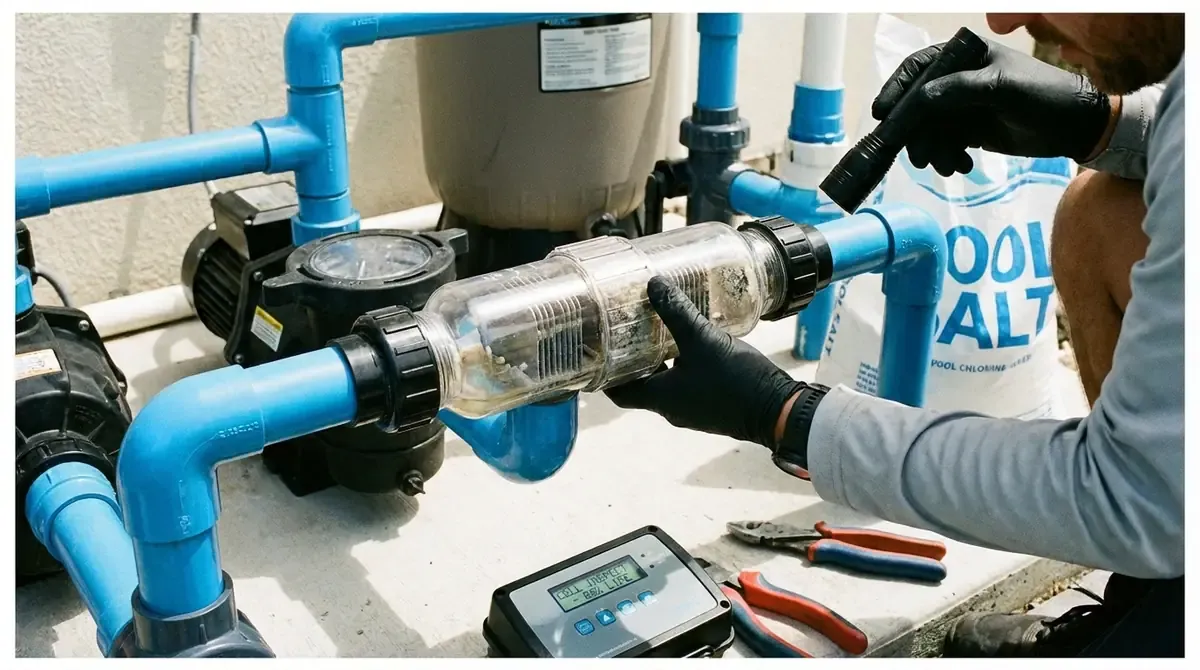
Start with our saltwater pool maintenance guide if you’re new to salt systems. This page focuses specifically on the chemistry differences and the target numbers that change when you run an SWG.
For pool water chemistry fundamentals that apply to all pool types, that guide covers the basics we won’t repeat here.
Video: “Salt Water Pool Maintenance for Beginners” by Swim University
What changes vs. a chlorine pool (quick reference)
Most parameters stay the same. Three change. Here is the complete comparison:
| Parameter | Chlorine Pool | Saltwater Pool | Why It Differs |
|---|---|---|---|
| Free Chlorine (FC) | 2-4 ppm | 2-4 ppm | No difference, same target |
| pH | 7.4-7.6 | 7.4-7.6 | Same target; rises faster in SW |
| pH drift rate | Slow, variable | 0.2-0.4/week | Electrolysis raises pH consistently |
| Total Alkalinity | 80-120 ppm | 80-120 ppm | Same target |
| Calcium Hardness | 200-400 ppm | 200-400 ppm | More critical at low end with salt |
| CYA (Stabilizer) | 30-50 ppm | 60-90 ppm | SWG produces unstabilized chlorine |
| Salt | N/A | 2,700-3,400 ppm | New parameter to monitor |
Data sourced from SwimUniversity and River Pools saltwater chemistry guidelines. Learn how to test and adjust salt levels for that specific parameter.

Why CYA is higher in a saltwater pool
CYA (cyanuric acid, also called stabilizer) protects chlorine from UV degradation by sunlight. Without it, chlorine breaks down rapidly in direct sun.
Saltwater pools require CYA at 60-90 ppm, higher than the 30-50 ppm standard for chlorine pools. The reason: salt chlorine generators produce unstabilized chlorine continuously, requiring more UV protection throughout the day.
In a traditional chlorine pool, you typically dose with Tri-Chlor tablets or Di-Chlor granules. Both products contain CYA, so every dose gradually builds up your stabilizer level. By contrast, an SWG produces chlorine without adding any CYA. The CYA you start with stays at the same level unless you dilute or add more.
The TroubleFreePool community describes SWG production as “unstabilized chlorine 24/7”, without adequate CYA shielding, sunlight can halve chlorine levels within hours. This is why the target range is nearly double what a manually-dosed pool needs.
For more on the relationship between CYA and chlorine effectiveness, see managing CYA (stabilizer) in your pool. The TroubleFreePool pool chemistry fundamentals guide explains the CYA-to-free-chlorine relationship in detail.
What happens at different CYA levels:
- Below 60 ppm: Chlorine degrades too fast in sun; the SWG cannot keep up; green water becomes likely
- 60-90 ppm: Ideal range for SWG operation; chlorine has adequate UV protection without becoming ineffective
- Above 90 ppm: “Chlorine lock” risk; CYA reduces chlorine effectiveness so much that even adequate chlorine levels cannot sanitize properly
CYA in a saltwater pool only rises if you add stabilizer directly, or if you use Di-Chlor or Tri-Chlor to supplement. If you shock with liquid chlorine (sodium hypochlorite), CYA stays flat. This matters when planning your manual dosing strategy.
Why saltwater pools need more muriatic acid
The consistent pH rise in saltwater pools is a predictable result of how electrolysis works. When the SWG splits water molecules to produce chlorine, it releases hydrogen gas as a byproduct. That hydrogen gas dissolving back into pool water raises pH. Expect pH to rise 0.2-0.4 per week with the SWG running at normal output, according to River Pools saltwater chemistry data.
Higher SWG output percentage means faster pH rise. Pools running at 80-100% output will see the top end of that range; pools at 40-50% will drift more slowly.
The correction is the same muriatic acid you’d use in any pool, just applied more frequently. We recommend testing pH twice per week instead of the standard once-per-week schedule for chlorine pools. Add muriatic acid in the evening near a return jet, never near the skimmer or directly at the cell inlet. Lower slowly: overcorrecting pH downward is harder to fix than letting it drift slightly high.
Some pools install a CO2 injection system to automatically counteract pH rise. This is an advanced option that makes sense for pools with very consistent high output or owners who want a hands-off chemistry routine.
Calcium hardness: more important in saltwater pools
Target calcium hardness (CH) is 200-400 ppm, the same as a standard chlorine pool. But the consequences of missing that range are more severe with a salt system.
Salt water at low calcium hardness becomes corrosive. It leaches minerals from pool surfaces, plumbing, and equipment more aggressively than low-CH chlorine water. Fiberglass pools are especially sensitive, low CH can etch the surface.
High calcium hardness (above 400 ppm) accelerates salt cell scaling. Calcium deposits build up on the cell plates faster, requiring more frequent cleaning. If your CH is above 400 ppm, River Pools recommends diluting with fresh water to both reduce scaling frequency and protect equipment.
Maintain CH in the 250-350 ppm range as your practical target within the 200-400 ppm window. This gives you buffer in both directions before hitting the problem zones.
The complete saltwater chemistry target table
Use this as your reference for every chemistry test. These are the targets we verify against the KB data from SwimUniversity and River Pools:
| Parameter | Ideal Target | Acceptable Range | Action If Out of Range |
|---|---|---|---|
| Free Chlorine | 3 ppm | 2-4 ppm | Adjust SWG output percentage |
| pH | 7.5 | 7.4-7.6 | Muriatic acid (lower) / soda ash (raise) |
| Total Alkalinity | 100 ppm | 80-120 ppm | Baking soda (raise) / muriatic acid (lower) |
| Calcium Hardness | 300 ppm | 200-400 ppm | Calcium chloride (raise) / dilute (lower) |
| CYA (Stabilizer) | 70-80 ppm | 60-90 ppm | Add stabilizer (raise) / partial drain (lower) |
| Salt Level | 3,200 ppm | 2,700-3,400 ppm | Add pool salt (raise) / dilute (lower) |
The ideal salt level for residential saltwater pools is 3,200 ppm, a range of 2,700-3,400 ppm is acceptable. Below 2,700 ppm, most SWGs shut down or underperform. Above 3,400 ppm, salt becomes corrosive to pool equipment.
For the EPA water chemistry reference, the EPA provides standards for drinking water but does not regulate recreational pool chemistry. Pools follow industry standards from organizations like the Association of Pool and Spa Professionals (APSP).
When to add manual chlorine to a saltwater pool
Your SWG produces chlorine continuously, so manual dosing is normally unnecessary. There are three situations where adding chlorine manually makes sense:
- SWG underperforming due to a dirty cell or low salt level. Clean the cell or adjust salt before you shock. Adding chlorine without fixing the root cause is temporary.
- Heavy bather load. Pool parties, vacation guests, or kids swimming daily can overwhelm SWG output. A liquid chlorine boost keeps levels in range.
- Algae treatment. Treating an algae outbreak requires temporarily raising chlorine to SLAM level (Shock Level and Maintain), which the SWG cannot achieve alone.
For manual dosing in a saltwater pool, use liquid chlorine (sodium hypochlorite). It adds no CYA, which matters because your CYA is already at 60-90 ppm. Avoid Tri-Chlor tablets in saltwater pools: they contain CYA, and adding more stabilizer when you’re already at the upper range pushes CYA above 90 ppm faster.
If you’re seeing common saltwater pool problems like green water or persistent low chlorine, that guide covers the diagnostic steps.
Saltwater pool chemistry FAQ
Do saltwater pools need less chlorine?
No. Saltwater pools require the same free chlorine level (2-4 ppm) as chlorine pools. The difference is automation: your salt cell produces the chlorine automatically instead of you adding it manually. The chemistry targets for sanitization are identical regardless of how the chlorine is generated.
Why does my pH keep rising in my saltwater pool?
This is a normal side effect of electrolysis. Your salt cell splits water molecules to produce chlorine, releasing hydrogen gas as a byproduct. When hydrogen dissolves back into pool water, it raises pH. Expect a rise of 0.2-0.4 per week and correct with muriatic acid. This is not a malfunction; it’s an inherent characteristic of SWG operation.
What happens if my CYA is too high in a saltwater pool?
CYA above 90 ppm reduces chlorine effectiveness, sometimes called “chlorine lock.” Chlorine is technically present but rendered ineffective by excess stabilizer. The only remedy is a partial drain and refill with fresh water to dilute CYA. No chemical product can reduce CYA once it exceeds the target range.
Can I use pool tablets (Tri-Chlor) in a saltwater pool?
We do not recommend Tri-Chlor tablets in saltwater pools. They contain CYA, and saltwater pools already require a higher CYA target (60-90 ppm). Tablets push CYA above 90 ppm faster, risking chlorine lock. If you need to supplement chlorine output, use liquid sodium hypochlorite, which adds no CYA.
How often should I test saltwater pool chemistry?
Test free chlorine and pH twice per week during swim season (more frequently than the once-per-week standard for chlorine pools). Test total alkalinity, CYA, and calcium hardness monthly. Test salt level monthly and after any heavy rain or significant water loss. The faster pH drift of saltwater pools makes more frequent testing necessary.
Is there any chemical I don’t need in a saltwater pool?
The SWG replaces the need for weekly chlorine additions. You still need: muriatic acid (more frequently than a chlorine pool), pH up (soda ash) for occasional low-pH corrections, alkalinity increaser (baking soda), and CYA stabilizer if levels drop from dilution. You no longer need chlorine tablets, granular shock on a schedule, or weekly liquid chlorine. The chemical cost savings are real, averaging $150-$400 per year versus a manually-dosed chlorine pool.
How long does a salt chlorine generator cell last?
Most salt cells last 3-7 years with proper care. A well-maintained cell running at moderate output (50-70%) and cleaned with plain water first rather than routine acid washing will hit the high end of that range. Replacement cells cost $200-$700 depending on the brand and model. Budget roughly $50-$100 per year for amortized cell replacement when calculating your total pool operating costs.
For the complete maintenance picture covering equipment checks, cell inspection, and seasonal startup, visit our complete saltwater pool maintenance guide.