Saltwater Pool Algae: Why It Happens and How to Clear It
If your saltwater pool has gone green, we understand the frustration: you have an automatic chlorination system, why is there algae? The answer is straightforward. Saltwater pools get algae for the same reason chlorine pools do: free chlorine dropped too low. The SWG produces chlorine automatically, but if it can’t keep up due to a dirty cell, low salt, or chemistry imbalance, algae gets a foothold within 24-48 hours.
SWGs produce unstabilized chlorine, so CYA at 60-90 ppm is essential protection against UV degradation. Without adequate stabilizer, the chlorine your cell produces degrades before it can accumulate. For a broader look at algae types and treatment, see our pool algae treatment guide. For overall care, start with our saltwater pool maintenance guide.
We’ll walk you through why it happened, how to treat it, and how your cell maintenance directly prevents future outbreaks.
Video: how to clear a green pool fast
Video: “How To Clear A Green Pool FAST” by Swim University
Why Saltwater Pools Get Algae
The SWG doesn’t change the fundamental chemistry, your pool still runs on chlorine. What the SWG changes is how that chlorine is produced. When production falls below demand, algae grows. Here are the SWG-specific causes we see most often:
-
Scaled salt cell. Calcium deposits build up on cell plates and reduce chlorine output. A heavily scaled cell may produce only a fraction of its rated output, enough for the display to show “running” but not enough to maintain adequate FC. Algae blooms within 24-48 hours of FC dropping to zero.
-
Low salt level. The SWG shuts down or underproduces when salt drops below 2,700 ppm. If the SWG display shows a “low salt” alarm, chlorine production stops.
-
CYA too low (below 60 ppm). SWGs produce unstabilized chlorine continuously. Without CYA at 60-90 ppm, UV sunlight destroys that chlorine faster than the cell produces it. Even a properly functioning SWG at adequate salt levels cannot maintain FC if CYA is insufficient.
-
pH too high (above 7.8). Chlorine is chemically less active at high pH. The chlorine is present, but its sanitizing effectiveness drops significantly. Many pool owners with green water and “normal” FC readings discover high pH is the culprit.
-
SWG output percentage too low. Summer heat, heavy bather loads, and pool parties all increase chlorine demand. An SWG set at 50% in June may have been sufficient in May, by July, that same setting leaves the pool under-sanitized.
-
SWG off during winter. Pools that enter spring with no chlorine production and no chlorine reserves are algae-prone the moment water warms above 60°F.
Saltwater pools get algae when chlorine production falls below demand. The most common cause is a scaled salt cell that can no longer produce adequate output. Regular cell cleaning every 30-90 days is the primary algae prevention step for SWG pools.
For a detailed walkthrough of other saltwater issues, see our guide on common saltwater pool troubleshooting.
Diagnosing your saltwater algae
Identify what you’re dealing with before reaching for chemicals. The type and severity affects how aggressively you need to treat.
| Appearance | Algae Type | Severity | Treatment |
|---|---|---|---|
| Green/cloudy water | Green algae | Moderate | Shock + brush |
| Green/black spots on walls | Green or early black | Moderate-severe | Shock + scrub spots |
| Yellow/mustard tint, brushes off easily | Mustard algae | Severe | Multiple shock rounds |
| Dark green/black stubborn spots | Black algae | Severe | Professional help likely needed |

SWG-specific check before treating: Test free chlorine, salt level (2,700-3,400 ppm target), CYA, and pH. Treating algae without fixing the root cause means it returns within a week. The SwimUniversity pool algae treatment guide{:target=“_blank”} has additional background on algae types if needed.
How to Treat Algae in a Saltwater Pool
This is a 6-step process. The order matters, skipping the chemistry check at the beginning is the most common reason treatment fails and algae returns.
Step 1: Test and fix chemistry first
Test FC, pH, CYA, and salt level before adding anything else. Adjust pH to 7.2-7.4 before shocking, higher pH significantly reduces shock effectiveness, meaning you waste chemicals. Verify salt level is 2,700-3,400 ppm so the SWG can assist during recovery once you restart it.
If CYA is below 60 ppm, add pool-grade cyanuric acid and wait 24 hours before shocking. Shocking into low-CYA water wastes chlorine rapidly. Target saltwater pool chemistry targets before proceeding.
Step 2: Clean the salt cell
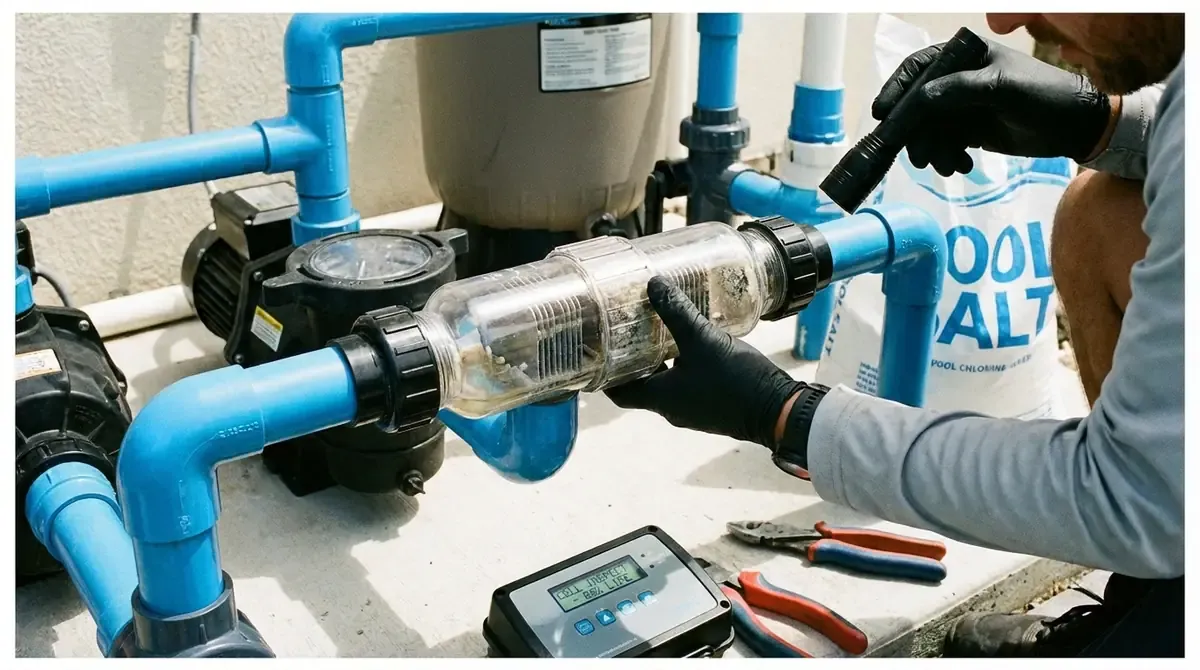
Turn off the SWG and remove the cell for inspection. Hold it up to the light, if white calcium deposits are visible on the plates, clean before treating. A scaled cell cannot contribute meaningfully to recovery even if you restart it after shocking. For cleaning steps, see our guide on how to clean your salt cell to prevent algae.
Step 3: Shock the pool manually
Do not rely on the SWG to shock an algae-infected pool. The SWG at maximum output is not capable of delivering the concentrated dose needed to kill active algae quickly, it’s designed for steady maintenance, not remediation.
Use liquid chlorine (sodium hypochlorite). Liquid chlorine adds no CYA, so it won’t push stabilizer into a problematic range. For guidance on the shock process, see how to shock a pool.
Dose based on algae severity:
- Green algae: 2x normal shock dose
- Yellow or dark green: 3x normal shock dose
- Black algae: 4x normal shock dose (and expect multiple rounds)
Standard reference: 1 lb of calcium hypochlorite per 10,000 gallons for a normal dose. For the SLAM (Shock Level and Maintain) method used by TroubleFreePool, the most precise approach, raise FC to SLAM level based on your CYA (at 70 ppm CYA, SLAM FC = approximately 28 ppm). See the TroubleFreePool SLAM method{:target=“_blank”} for the FC/CYA chart.
Shock in the evening. Daytime UV degrades chlorine before it can work. Night treatment maximizes effectiveness.
Step 4: Brush and run the filter
Immediately after adding shock, brush all pool surfaces, walls, floor, steps, and any areas where algae is visually concentrated. Brushing releases algae from surfaces and exposes it to the chlorine.
Run the filter continuously for 24-48 hours. Backwash or clean the filter when pressure rises 8-10 PSI above its normal clean baseline.
Step 5: Clear the dead algae
Cloudy blue water after shocking is a success indicator, not a failure. Dead algae suspended in the water creates that cloudiness. Keep FC at shock level until the water is crystal clear. SLAM completion requires: CC at 0.5 ppm or lower, overnight chlorine loss of 1.0 ppm or less, and water that’s visibly clear.
Clarifier helps speed coagulation for cartridge filter owners. Sand filter owners can add a small amount of pool-grade DE to improve filtration speed.
Step 6: Restart the SWG and address the root cause
Once water is clear and FC has returned to the normal 2-4 ppm range, restart the SWG. Now address the original root cause: clean the cell if it was scaled, adjust output percentage for summer demand, correct CYA if it was low, or commit to weekly pH testing.
Preventing algae in a saltwater pool
Prevention requires maintaining FC above 2 ppm at all times. For SWG pools, that depends almost entirely on three things: a clean cell, adequate CYA, and pH in range.
The best algae prevention for saltwater pools is a clean salt cell. A scaled cell produces less chlorine, every month without cleaning is a month closer to an algae bloom.
- Cell cleaning on schedule: Every 30-90 days, depending on your water hardness. Hard water areas require more frequent inspection. A quarterly schedule is a reasonable default.
- CYA at 60-90 ppm: This is the #1 prevention factor specific to salt pools. Without CYA, SWG chlorine degrades under UV before it can accumulate. Test CYA monthly.
- Bump SWG output in summer: Increase output percentage in June-August when heat and bather load increase chlorine demand. Drop it back in September.
- Weekly pH check: pH above 7.8 makes existing chlorine less effective. Even adequate FC at high pH doesn’t kill algae efficiently. Keep pH at 7.4-7.6.
- Algaecide: Generally not needed if FC is maintained. TroubleFreePool’s research demonstrates that algae cannot survive in properly chlorinated water, if FC stays above 2 ppm, algaecide is a symptom treatment, not a root cause solution.
Saltwater pool algae FAQ
Can I use algaecide in a saltwater pool?
Yes, algaecides are compatible with saltwater pools. However, TroubleFreePool’s research shows algae cannot survive in properly chlorinated water, if FC is maintained above 2 ppm, algaecide is unnecessary. It addresses the symptom, not the root cause. If algae keeps returning despite algaecide use, the underlying issue is insufficient chlorine production, low CYA, or high pH.
Do I need to turn off my SWG when shocking?
Yes. Turn off the SWG before adding liquid chlorine or calcium hypochlorite shock. The high chlorine concentration at the point of addition can temporarily stress the cell if the SWG is running during dosing. Restart the SWG after the shock has circulated for 2-4 hours.
Why did my saltwater pool turn green overnight?
Algae can turn a pool visibly green within 12-24 hours when FC drops to zero. The most likely causes: SWG output was set too low for current demand, the cell was scaled and stopped producing adequate chlorine, or a pH spike reduced chlorine effectiveness to near zero while FC appeared adequate on test strips.
Can I swim in a pool with algae?
We recommend against it. Algae itself is not particularly harmful, but pools with algae can harbor bacteria including E. coli and other pathogens that thrive alongside it. Cloudy water is also a drowning hazard, you can’t see the bottom. Wait until the pool is clear and FC is in the normal 2-4 ppm range before swimming.
How long does it take to clear a green saltwater pool?
A mild green pool typically clears in 24-72 hours with proper shocking and continuous filtration. Severe algae cases may take 5-7 days of continuous filtration and multiple chlorine additions. The limiting factor is usually filter capacity. DE filters clear fastest, cartridge filters in the middle, sand filters slowest. Sand filter owners can add pool-grade DE to speed up clearing.