Salt Chlorine Generator: How It Works, Best Models, and Costs
A salt chlorine generator (SWG) converts dissolved salt in your pool water into chlorine automatically via electrolysis. You add no weekly chlorine — the system produces it continuously, maintaining more consistent levels than manual dosing. Setup costs run $500-$2,500 for the unit; installation is DIY-possible for most homeowners with basic plumbing skills. This guide covers how they work at the chemistry level, the top models by price point, and how to decide when to replace your cell. For the full saltwater pool maintenance picture, see our saltwater pool maintenance guide.
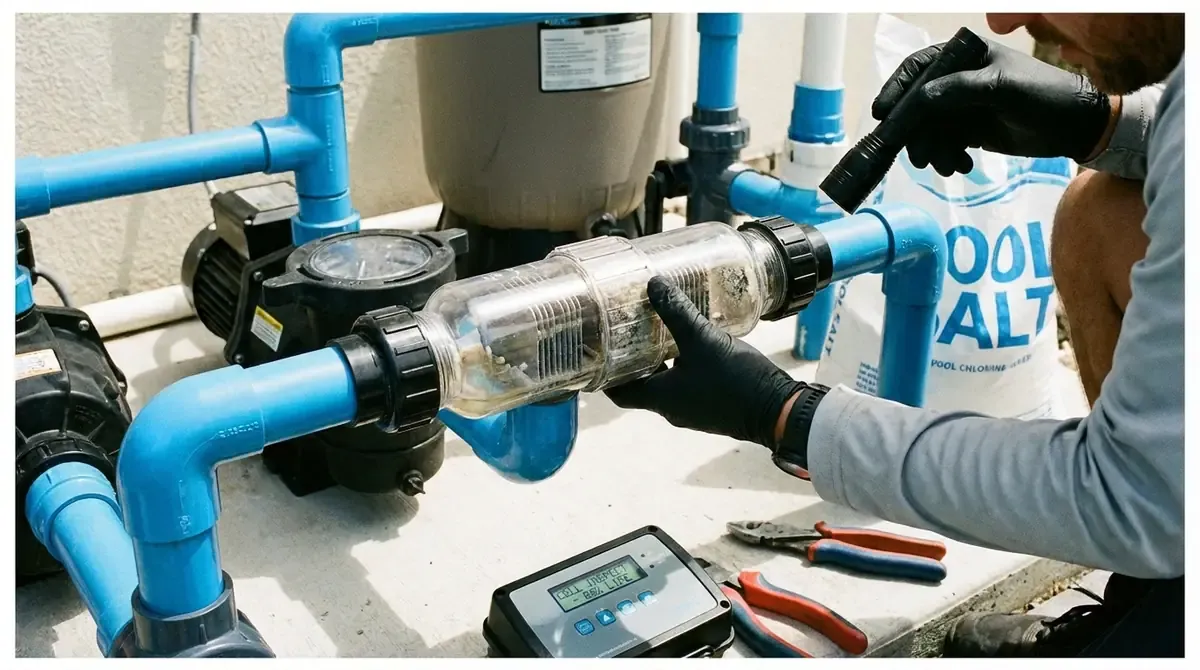
How a salt chlorine generator works
A salt chlorine generator works by passing a DC electrical current through titanium plates coated with precious metals — ruthenium and iridium — which convert dissolved sodium chloride into hypochlorous acid, the same active form of chlorine found in all pool sanitizers.
Here is the chemistry in plain terms:
- You dissolve pool-grade salt (NaCl) in your pool water to a target of 3,200 ppm (range: 2,700-3,400 ppm)
- Pool water flows through the cell housing
- DC current passes between the titanium plates
- Electrolysis splits the salt molecules: the chloride ions convert to hypochlorous acid (HOCl), which sanitizes the pool
- The sodium ions recombine with water to form sodium hydroxide
- Salt is not consumed in this reaction — it regenerates continuously. Losses only happen through splash-out, backwashing, or heavy rain dilution
The cell plates’ precious metal coating is what makes this process possible. Ruthenium and iridium are the active catalysts. Once that coating is degraded — by abrasive tools, excessive acid washing, or age — the cell cannot be restored. This is why proper cleaning technique matters as much as cleaning frequency.
Because SWGs produce unstabilized chlorine around the clock, CYA must be maintained at 60-90 ppm to prevent UV degradation. A pool without enough CYA will consume SWG chlorine rapidly and stay under-sanitized despite the system running at full output.

Salt chlorine generator specs: what matters
| Spec | What It Means | Typical Range |
|---|---|---|
| Pool size rating | Max pool volume the unit can sanitize | 10,000-80,000 gallons |
| Chlorine output | Lbs of chlorine produced per day | 0.5-2.5 lbs/day |
| Salt level requirement | Operating range for optimal production | 2,700-3,400 ppm |
| Cell lifespan | Expected years before replacement | 3-7 years |
| Operating temperature | Minimum water temp for efficient production | 60°F (16°C) |
| Cell replacement cost | Cost to replace cell when worn | $200-$700 |
| Unit cost (full system) | Controller plus cell upfront | $500-$2,500 |
Sizing matters more than most buyers realize. We recommend buying a unit rated for a larger pool than you have. A cell running at 50-60% output lasts significantly longer than one running at 100% constantly. If your pool is 20,000 gallons, consider a unit rated for 30,000-40,000 gallons. The extra cost (usually $100-$200) pays back in extended cell life.
The opposite problem — undersizing — means running at 100% output constantly during summer heat spikes, leaving no headroom for high bather loads or hot stretches, and shortening cell life.
SWGs also become inefficient below 60 degrees Fahrenheit water temperature. Do not run the system through fall and winter — it adds cell wear without producing useful chlorine. For managing pool pH with muriatic acid during the active season, see our lowering pH with muriatic acid guide.
Top salt chlorine generator models
| Brand/Model | Pool Size Rating | Cell Cost | Notable Feature |
|---|---|---|---|
| Hayward AquaRite | Up to 40,000 gal | $200-$350 | Built-in 500-hour cell inspection reminder |
| Pentair IntelliChlor | Up to 40,000 gal | $350-$500 | ”Cell Low” output indicator; IntelliTouch integration |
| Jandy AquaPure | Up to 45,000 gal | $300-$450 | Requires separate test kit to verify output |
| Hayward AquaRite Pro | Up to 60,000 gal | $300-$400 | Wi-Fi monitoring; variable output control |
| CircuPool RJ | Up to 45,000 gal | $150-$250 | Budget option; strong aftermarket cell availability |
Brand-specific diagnostic behaviors worth knowing:
- Hayward AquaRite: Triggers a built-in cell inspection reminder every 500 hours of operation. This is a time-based prompt, not a performance reading — the cell may be fine at 500 hours or may already be scaled. Inspect visually when the reminder activates.
- Pentair IntelliChlor: Shows a “Cell Low” indicator when output drops below threshold. This is a more direct performance signal. Integrates cleanly with Pentair’s IntelliTouch automation systems if you have a full equipment package.
- Jandy AquaPure: The display does not confirm actual chlorine production level. You need a separate DPD test kit to verify the cell is actually producing. Many owners discover this gap when they find green water despite the system showing “normal” operation.
For full specifications, see Hayward AquaRite product specifications{:target=“_blank”} and Pentair IntelliChlor specifications{:target=“_blank”} from the manufacturers directly. For general water quality context, the EPA water quality standards{:target=“_blank”} apply regardless of sanitization method.
For a direct cost comparison between saltwater and chlorine pool ownership, see our saltwater vs chlorine pool cost comparison.
How to install a salt chlorine generator
Installation involves three main tasks: cutting and plumbing the cell inline, mounting the controller, and adding salt. Here is a high-level orientation — not a full tutorial, but enough to know what you are committing to:
Installation location: The cell must go inline with the return line, after the filter and heater. Heat degrades the cell faster — placing it before the heater shortens lifespan. The cell needs flow to operate; most units have a flow sensor that prevents operation if pump flow is too low.
Plumbing steps (overview):
- Cut the return PVC pipe
- Install union fittings on each side of the cell housing (unions allow future removal for cleaning and replacement)
- Mount the controller box on a wall near the equipment pad
- Wire the controller to the timer or panel (follow local electrical code; consult a licensed electrician if you are not comfortable with this step)
Salt addition:
- Use only pool-grade sodium chloride (NaCl) rated at 99.8% purity or higher. See the FAQ section below for details on what not to use.
- Add salt gradually with pump running. Brush the pool floor to help dissolve.
- Run the pump 24 hours before turning on the SWG — salt needs to fully dissolve and circulate to an even level before the cell starts producing
For the complete step-by-step process including salt quantity calculations, see our how to convert a pool to saltwater guide.
Video guide
Video: “How To Install a Salt Pool System” by Discount Salt Pool
Salt cell lifespan and when to replace
Expected lifespan: 3-7 years with proper care. The range is wide because cell care has a large impact.
Factors that shorten lifespan:
- Running at 100% output constantly (buy oversized to avoid this)
- Low salt levels (below 2,700 ppm) — the cell works harder and heat output increases
- High calcium hardness (above 400 ppm) — accelerates scale formation on plates
- Excessive acid washing — each acid wash removes a microscopic layer of the precious metal coating
Factors that extend lifespan:
- Maintaining proper salt level (not too high or too low — corrosive at both extremes)
- Oversizing the unit so it runs at 50-70% output
- Plain water soak before any acid wash — often removes light scale without chemicals
- Inspecting every 30-90 days and cleaning before scale becomes heavy
Signs it is time to replace:
- Output consistently low after a thorough cleaning and correct salt level is confirmed
- Visible physical damage to the plates (pitting, delamination)
- Production drops below 80% of rated output with no improvement from cleaning
On the “replace vs clean” decision: we have found that owners often replace cells prematurely. A cell showing low output should always get a thorough cleaning — plain water soak first, then acid wash if needed — before replacement is considered. A scaled cell mimics a failing cell in every measurable way. See our guide on how to clean your salt cell before spending $200-$700 on a replacement.
TroubleFreePool forum experts note that a five-year cell with no acid washing is a sign of excellent care. The precious metal coating (ruthenium and iridium) on the plates is permanent and irreplaceable once degraded — once gone, the cell cannot be restored and replacement is necessary.
For managing the pool chemistry that affects cell lifespan, see our pool water chemistry balance reference.
Salt chlorine generator FAQ
What is the difference between a salt cell and a salt chlorine generator?
The terms are used interchangeably. The “cell” refers to the physical electrode component — the housing containing the titanium plates. The “salt chlorine generator” or “SWG” refers to the complete system, including the controller unit and the cell. When people say their “salt cell needs cleaning,” they mean the electrode component specifically.
How much salt do I need to start up my SWG?
To reach 3,200 ppm in a pool starting from zero salt, figure approximately 50 lbs of pool-grade salt per 10,000 gallons of pool water. A 20,000-gallon pool needs roughly 100 lbs to start. Add the salt gradually with the pump running, let it dissolve fully (24 hours), then turn on the SWG.
Why does my SWG keep showing a low salt reading?
Low salt readings with correct salt levels usually point to one of three causes: the cell is scaled (calcium buildup throws off the conductivity reading), the salt sensor is dirty or failing, or the salt genuinely is low due to recent heavy rain or backwashing. Test your salt level with a separate test strip or kit to confirm the actual level before adding more salt.
Can I use any type of salt in my pool?
Use only pool-grade sodium chloride (NaCl) rated 99.8% purity or higher. Do not use rock salt, iodized table salt, ice melt, or water softener salt. These products contain additives — iodine, anti-caking agents, or other minerals — that damage cell plates, cloud pool water, and interfere with salt sensors. Pool-grade salt is available at pool supply stores and costs $5-$10 for a 40-lb bag.
How do I know if my salt cell is failing vs just dirty?
Clean the cell first with a plain water soak, then an acid wash if light scaling remains. If output is still low after a thorough cleaning and salt level is confirmed at 3,200 ppm, the cell is likely at end of life. Visible damage to the plates — pitting, delamination, or discoloration — confirms failure. A clean cell with correct salt that still underproduces needs replacement.
Does the SWG replace all pool chemicals?
No. The SWG produces chlorine, but you still need to manage pH (using muriatic acid to counter the SWG’s pH-raising effect), total alkalinity, calcium hardness, and CYA. The SWG reduces chemical work significantly — no weekly chlorine additions — but does not eliminate pool chemistry management. Expect to add muriatic acid every 1-2 weeks during swim season to control the 0.2-0.4 pH rise per week that SWGs cause.