Pool Stabilizer: What It Is and Exactly How Much to Add
Pool stabilizer (cyanuric acid, or CYA) protects your free chlorine from UV breakdown. Target 30-50 ppm for outdoor chlorine pools and 60-90 ppm for saltwater or SWG pools. To raise CYA by 10 ppm, add 1 lb of granular stabilizer per 4,000 gallons of pool water. Without any stabilizer, a pool loses 50-90% of its chlorine within 2 hours of direct sun. At 30 ppm CYA, that same amount of chlorine lasts 7 hours. This is the complete guide to pool stabilizer: what it is, when you need it, how much to add, and what to do if you have too much. For a full overview of all pool chemistry parameters, see our complete pool chemistry guide.
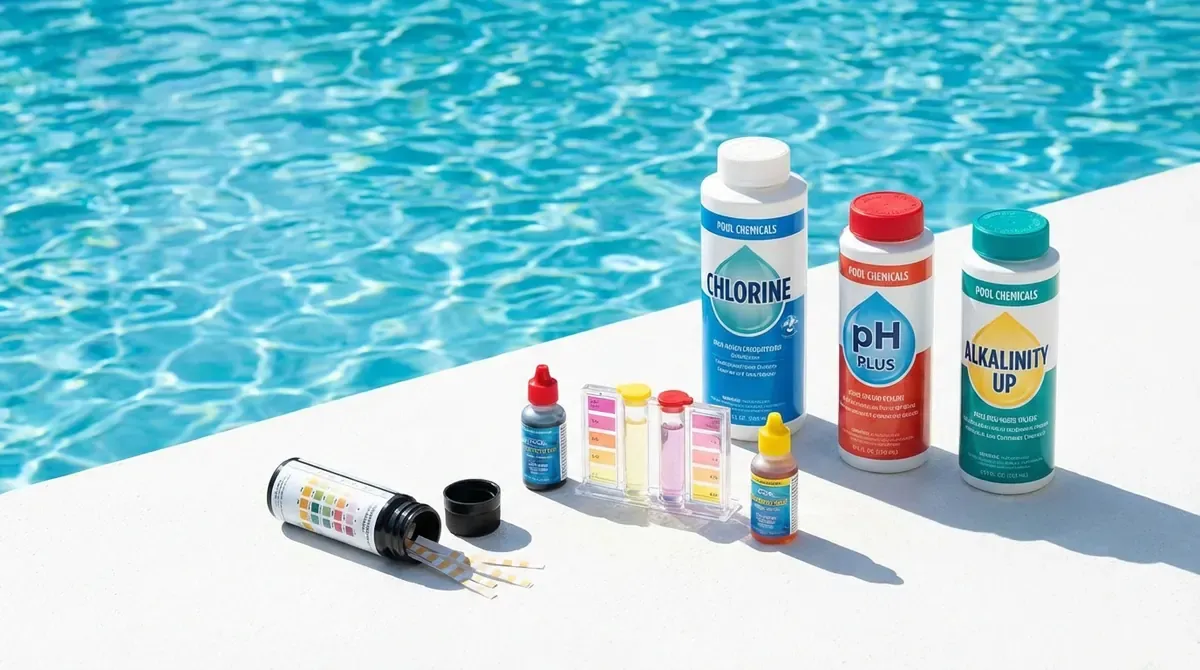
What is pool stabilizer?
Pool stabilizer, cyanuric acid, and pool conditioner are the same product, three names for one chemical. CYA forms a weak, temporary bond with free chlorine that shields it from UV radiation. When UV light hits the bond, it breaks down without consuming the chlorine itself, so your FC stays in the water longer.
A few key points to understand upfront:
- CYA does not change how much chlorine you add. It makes the chlorine you already have last longer.
- Without CYA, 50% of free chlorine is lost within 35 minutes of direct sunlight (TroubleFreePool data).
- With 30 ppm CYA: 50% FC loss takes 7 hours instead.
- Pentair confirms that UV alone destroys unstabilized chlorine within 45 minutes.
See CDC chlorine disinfection standards for background on why UV resistance matters in outdoor pool sanitation.
Video: “How To Balance CYANURIC ACID” by Swim University
Do you actually need pool stabilizer?
You do need it if:
- You have an outdoor chlorine pool and have never added stabilizer
- Chlorine keeps disappearing within 24 hours despite correct pH and regular dosing
- You are filling a new pool for the first time
- Your current CYA level is below 20 ppm
You do not need it if:
- You have an indoor pool with no UV exposure
- Your CYA is already testing at 50+ ppm for a standard pool
- You have a saltwater pool, add when CYA drops below 60 ppm
If you use chlorine tablets exclusively, your CYA is probably rising whether you add stabilizer or not. This is one of the most common sources of “chlorine not holding” problems, the CYA has climbed so high that chlorine becomes ineffective. See our cyanuric acid levels and adjustment guide for how to diagnose this.
Target CYA levels for different pool types
| Pool Type | CYA Target | Notes |
|---|---|---|
| Standard outdoor chlorine | 30-50 ppm (ideal: 40 ppm) | Test monthly |
| Saltwater / SWG pool | 60-90 ppm | SWGs need more UV protection |
| Indoor pool | 0-20 ppm | Minimal sun exposure; low stabilizer fine |
CYA is not consumed by normal pool use. It only leaves your pool through draining, splash-out, or backwashing the filter. This means it accumulates over time, especially if you use stabilized chlorine tablets.
The FC/CYA relationship matters a great deal for proper sanitation. At 50 ppm CYA, you must maintain a minimum of 4 ppm free chlorine. At 30 ppm CYA, 2 ppm FC is sufficient. Above 100 ppm CYA, the chlorine that is required to sanitize effectively becomes impractically high. Leslie’s recommends draining when CYA exceeds 100 ppm. TFP notes that at above 90 ppm CYA, the SLAM process becomes very difficult because SLAM-level FC doses become enormous.
Here is the TFP minimum FC table by CYA level. We recommend bookmarking this:
| CYA level | Minimum FC | SLAM FC level |
|---|---|---|
| 20 ppm | 2 ppm | 12 ppm |
| 30 ppm | 2 ppm | 12 ppm |
| 40 ppm | 3 ppm | 16 ppm |
| 50 ppm | 4 ppm | 20 ppm |
| 60 ppm | 5 ppm | 24 ppm |
| 70 ppm | 6 ppm | 28 ppm |
| 80 ppm | 7 ppm | 31 ppm |
| 90 ppm | 8 ppm | 35 ppm |
See the full TroubleFreePool FC/CYA minimum chart for the complete reference.
How much pool stabilizer to add (dosing table)
The standard dosing rate for pool stabilizer is 1 lb of granular cyanuric acid per 4,000 gallons to raise CYA by 10 ppm.
Use this table to find your dose:
| Target increase | 10,000 gal | 15,000 gal | 20,000 gal |
|---|---|---|---|
| +10 ppm | 2.5 lbs | 3.75 lbs | 5 lbs |
| +20 ppm | 5 lbs | 7.5 lbs | 10 lbs |
| +30 ppm | 7.5 lbs | 11.25 lbs | 15 lbs |
Example: 15,000 gallon pool currently at 10 ppm CYA that needs to reach 40 ppm: add approximately 11.25 lbs of granular stabilizer in two rounds (7.5 lbs first, retest after 48 hours, then adjust).
Do not add more than 30 ppm worth at one time. CYA absorbs slowly and takes 24-48 hours to fully register on a test kit. Adding more before it registers is how pools end up over-stabilized.

Step-by-step: how to add pool stabilizer safely
What you need: measuring scale, 5-gallon bucket, warm water, chemical-resistant gloves
- Test current CYA level first. Never skip this. Liquid test kits or a pool store test are more accurate than strips for CYA. If you already have 50 ppm CYA, adding more stabilizer creates a bigger problem than the one you are solving.
- Calculate your dose using the table above. If your pool is between the sizes listed, interpolate: a 12,000 gallon pool needs about 3 lbs of stabilizer to raise CYA by 10 ppm.
- Fill a 5-gallon bucket 1/3 to 1/2 full with warm pool water. Pour the measured granular CYA into the bucket slowly (not the other way around, water to chemical, not chemical to water). See EPA pool chemical safety guidelines for safe chemical handling.
- Stir until dissolved. CYA dissolves slowly, especially in cold water. Warm water speeds this up. The solution may remain slightly cloudy.
- Pour the dissolved solution into the skimmer with the pump running. Do not pour directly into the pool as granular CYA can bleach a liner or leave a deposit on the pool floor if it settles undissolved.
- Run the pump for 24-48 hours. During this time, do not backwash or clean the filter, you will flush the CYA out before it registers in the water.
- Retest after 48 hours. If still below target, add a second partial dose and repeat.
Safety note: CYA is a mild eye and skin irritant. Wear gloves and avoid inhaling dust from the granules. The AAA rule applies: Always Add Acid (or any concentrated chemical) to water, never water to the chemical. For muriatic acid used alongside this process, see our guide on muriatic acid for pH adjustment.
For balancing alkalinity as part of your overall chemistry adjustment, see how to raise pool alkalinity.
What if CYA is too high?
CYA cannot be removed chemically. The only fix is dilution through partial draining and refilling.
- Drain 25%: Reduces CYA proportionally. A pool at 100 ppm CYA drops to approximately 75 ppm after a 25% drain-refill.
- Drain 50%: More aggressive. A 15,000 gallon pool at 120 ppm CYA drops to approximately 60 ppm after draining and refilling 7,500 gallons.
When to drain: Leslie’s recommends draining when CYA exceeds 100 ppm. TFP says above 90 ppm, the SLAM process becomes so demanding (requiring SLAM-level FC at 35+ ppm) that it is usually easier to drain.
Prevention is straightforward: if you use tablets as your primary chlorine source, test CYA monthly and switch to liquid chlorine when levels approach 70-80 ppm. Liquid chlorine adds no CYA, which gives you a way to chlorinate without accelerating stabilizer buildup.
FAQ
What is the difference between pool stabilizer and cyanuric acid?
Pool stabilizer, cyanuric acid, and pool conditioner are the same product, different names for the same chemical compound (cyanuric acid, CYA). You will see all three terms on product labels and in pool care guides. They are completely interchangeable.
How long does it take for pool stabilizer to work?
CYA takes 24-48 hours to fully dissolve and register in pool water. You may see a partial reading after 24 hours, but wait the full 48 hours before testing and deciding whether to add more. Running the pump continuously during this period helps the stabilizer disperse evenly.
Can I add pool stabilizer and chlorine at the same time?
We recommend adding them separately with at least 15-30 minutes between additions and the pump running the whole time. Adding both simultaneously is not dangerous, but the CYA needs time to disperse before the chlorine reading stabilizes. Test chlorine 24 hours after adding stabilizer, not immediately.
What happens if I add too much pool stabilizer?
High CYA (above 100 ppm) reduces chlorine effectiveness significantly, the condition pool stores call “chlorine lock.” At very high CYA levels, you may need impossibly high FC doses to maintain proper sanitation. The only fix is partial draining. There is no chemical that removes CYA. For hot tub owners facing sanitizer questions, see our hot tub chemical balancing and hot tub sanitizer options guides.
Do I need pool stabilizer for an indoor pool?
No. Indoor pools receive no direct UV exposure, so chlorine degrades much more slowly. CYA at 0-20 ppm is fine for indoor pools. Adding stabilizer to an indoor pool is unnecessary and can create the same high-CYA problems described above without any benefit.