Pool Shock Treatment: Types, Timing, and Step-by-Step Guide
Pool shock is the most common pool fix, and the most often done wrong. The wrong shock type can add CYA you don’t need, the wrong dose can leave algae alive, and shocking at noon wastes half the product to UV degradation. This guide covers what pool shock actually does, the four types available, when to use each, exact dosing by pool size, and what to expect once it’s done. For our complete complete pool chemistry guide, start there first if you’re new to water balance.
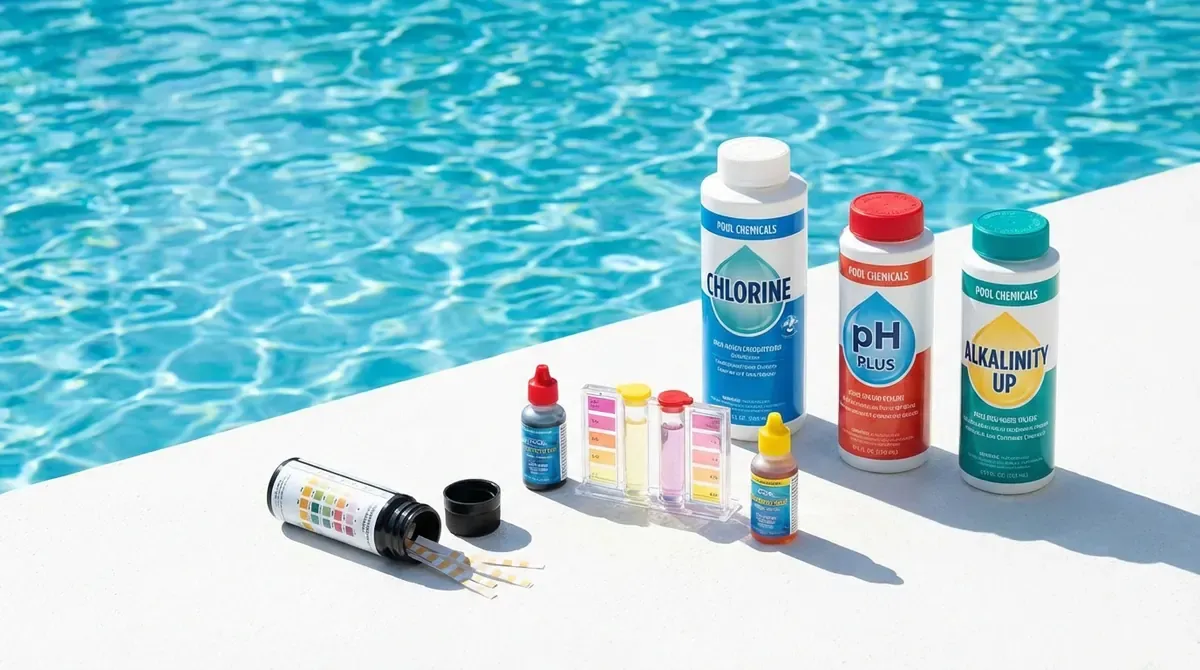
What does pool shock actually do?
Shocking your pool is not the same as adding regular chlorine. The process is called breakpoint chlorination, free chlorine (FC) must reach at least 10 times the combined chlorine (CC) level to break through chloramines completely. At that concentration, chlorine destroys chloramines, algae, and bacteria rather than just adding to them.
Pool shock works by raising free chlorine to at least 10 times the combined chlorine level. At that concentration, chlorine breaks down chloramines completely, eliminating pool odor and restoring water clarity.
Here’s something most pool owners get backwards: the strong “chlorine smell” coming from a pool is caused by chloramines (CC), not by free chlorine. Chloramines form when free chlorine reacts with ammonia, nitrogen, and contaminants from swimmers. The smell is the sign that you need to shock, not the sign that you’ve added too much chlorine. According to CDC pool chlorine disinfection standards{:target=“_blank”}, combined chloramines cause eye and respiratory irritation even at low concentrations.
A successful shock brings CC below 0.5 ppm. Water clears, the chlorine odor disappears, and free chlorine resumes its sanitizing work.
7 situations that require pool shock
Not every cloudy pool or drop in FC needs a shock treatment. Here are the specific triggers:
- Green, yellow, or cloudy water, visible algae growth means FC has failed to keep up
- CC above 0.5 ppm, combined chlorine confirmed on test; breakpoint chlorination required
- Strong chlorine smell that won’t go away, this is chloramines, not excess chlorine
- After heavy bather load, pool party, swim meet, or high-traffic weekend
- Opening pool for the season, water has sat stagnant and needs a full reset
- Closing pool for the winter, prevents algae growth during off-season
- After animal contamination, birds, wildlife, or other biological contamination events
One note on weekly preventive shocking: pool stores often recommend it as a habit. The TroubleFreePool method disagrees, if FC is maintained daily at the correct level for your CYA, routine shocking is unnecessary. Shock when you have a reason, not on a calendar schedule.
If algae is already visible, skip ahead to the SLAM section below. For green pool water treatment, we have a dedicated guide covering the full algae elimination process.
Video guide
Video: “How to SHOCK a POOL” by Swim University
The 4 types of pool shock (comparison)
The four types of pool shock differ in chlorine content and what they add to your water: Cal-Hypo (65-73% chlorine, adds calcium), Di-Chlor (56% chlorine, adds CYA), non-chlorine MPS (zero chlorine, swim-safe in 15 minutes), and liquid chlorine (10-12.5%, the purest option with no secondary additions).
| Shock Type | Active Chlorine | CYA Added | Calcium Added | Swim Wait | Best Use |
|---|---|---|---|---|---|
| Cal-Hypo 65% | 65-73% | None | Yes (slight) | 8-24 hours | Algae treatment, season opening |
| Di-Chlor 56% | 56% | +9 ppm per 10 ppm FC | None | 8 hours | Vinyl liner pools, quick shock |
| Non-Chlorine (MPS) | 0% (oxidizer only) | None | None | 15 minutes | Routine maintenance when water looks fine |
| Liquid Chlorine | 10-12.5% | None | None | 8 hours | SLAM process, daily chlorination |
Cal-Hypo is the workhorse. Most powerful, most common, most appropriate for algae treatment and season opening. It must be pre-dissolved in a bucket before adding, never pour granules directly onto pool surfaces (bleaching risk). Raises calcium hardness slightly over time.
Di-Chlor dissolves fast and can be broadcast directly. The catch: it adds about 9 ppm of CYA for every 10 ppm of FC it provides. Use it occasionally and it’s fine; rely on it heavily and CYA accumulates to levels that make chlorine ineffective. Best for vinyl liner pools where direct broadcasting is convenient.
Non-chlorine MPS is not a true shock, it’s an oxidizer that removes chloramines without adding chlorine. The 15-minute swim window is its main selling point. It does not kill algae. Use it for routine maintenance when water is clear and chemistry is balanced; never for algae treatment.
Liquid chlorine (sodium hypochlorite, 10-12.5%) is the purest option. No CYA, no calcium, no complications. It degrades quickly in sunlight, so add after dark. We recommend liquid chlorine as the preferred choice for the SLAM process: it adds nothing to the water except chlorine.
How much pool shock to add (dosing by situation)
Standard maintenance shock (10 ppm FC bump)
| Shock Type | 10,000 gal |
|---|---|
| Cal-Hypo 65% | 1.2 lbs |
| Di-Chlor 56% | 1.4 lbs |
Algae treatment shock (30 ppm FC target)
For algae, you need to hit 30 ppm FC, roughly three times the maintenance dose. We use Cal-Hypo 65% at 1.8 lbs per 5,000 gallons (3.6 lbs per 10,000 gallons); Di-Chlor 56% requires 2.1 lbs per 5,000 gallons (4.2 lbs per 10,000 gallons). These figures come from InTheSwim’s laboratory-verified dosage charts.
Cal-Hypo dosing table by pool size:
| Pool Size | Maintenance (10 ppm) | Algae treatment (30 ppm) |
|---|---|---|
| 10,000 gal | 1.2 lbs | 3.6 lbs |
| 15,000 gal | 1.8 lbs | 5.4 lbs |
| 20,000 gal | 2.4 lbs | 7.2 lbs |
SLAM level dosing: If you’re running the SLAM process, the target FC level is determined by your CYA concentration. At 50 ppm CYA, SLAM FC = 20 ppm. At 70 ppm CYA, SLAM FC = 28 ppm. See the FC/CYA chart in our complete pool chemistry guide for the full table.
See the step-by-step pool shocking guide for full instructions specific to your pool type (inground, above-ground, vinyl liner, or saltwater).
Step-by-step: how to shock your pool
Follow CPO chemical addition safety procedures{:target=“_blank”} throughout this process.
Before you start: check pH first. Shocking works best at pH 7.2-7.4. Above 7.6, chlorine is 30-50% less effective. If pH or low pool alkalinity is off, adjust those before adding shock.
- Test water, confirm CC above 0.5 ppm; check pH (target 7.2-7.4 before shocking)
- Calculate dose, use the table above for your pool size and situation
- Wait until dusk, UV radiation destroys chlorine within minutes of sun exposure; shocking at noon wastes the product
- Prepare Cal-Hypo, fill a 5-gallon bucket 1/3 full with pool water; slowly pour Cal-Hypo into the water (not water onto the chemical); stir with a non-combustible rod; pour slowly into the deep end. Broadcast Di-Chlor directly around the perimeter.
- Run pump 8-24 hours, circulation distributes the shock throughout the pool
- Test again, if FC drops rapidly back to baseline within a few hours, the pool is consuming the chlorine; add more and continue
Safety: wear old clothes (chlorine bleaches fabric permanently), acid-resistant gloves, and safety goggles. Never mix different shock products in the same bucket.
After state: what to expect after shocking
Cal-Hypo can make water appear milky-white briefly after application. We see this often and it’s normal; it clears within a few hours.
For algae treatment, water will turn cloudy blue or gray rather than clearing immediately. Gray or bluish-white cloudiness after shocking an algae-filled pool is the success state, it means dead algae suspended in the water. Allow the filter to run 24-48 hours to capture and remove dead algae. Backwash the filter after algae treatment.
Swim wait times by shock type:
- Cal-Hypo: 8-24 hours (test FC before swimming; must be below 5 ppm)
- Di-Chlor: 8 hours
- Non-chlorine MPS: 15 minutes
- Liquid chlorine: 8 hours or when FC drops below 5 ppm
If still green after 48 hours, you may need a second shock dose or the full SLAM process.
After the pool clears, consider adding pool algaecide after shocking to prevent regrowth, particularly useful for pools with a history of recurring algae problems.
If pool is still not clearing: the SLAM process
SLAM stands for Shock Level and Maintain. It’s the TroubleFreePool method for persistent algae and green water that doesn’t respond to standard shock treatment.
The key difference from standard shocking: you raise FC to the SLAM level for your CYA and then hold it there continuously until the pool passes all three completion tests.
- Adjust pH to 7.2-7.4 first
- Determine SLAM FC target from the FC/CYA chart (at 50 ppm CYA = 20 ppm; at 70 ppm CYA = 28 ppm)
- Use liquid chlorine, preferred because it adds no CYA, no calcium
- Test every 4-8 hours; re-dose immediately when FC drops
- Run pump 24/7; brush pool walls and floor daily
SLAM is complete when all three are true:
- Water is visually clear
- CC is below 0.5 ppm
- FC holds overnight (loses less than 1 ppm over 8 hours)
For the detailed SLAM walkthrough including what to do when FC won’t hold, see the TroubleFreePool SLAM process guide{:target=“_blank”}.
For shocking a hot tub, the process is similar but uses much smaller doses, hot tub water volume is typically 250-500 gallons.
FAQ
How long after shocking can I swim?
Wait at least 8 hours after Cal-Hypo or Di-Chlor shock, and 15 minutes after non-chlorine (MPS) shock. More importantly, test free chlorine before swimming regardless of timing. FC must be 5 ppm or below for safe swimming. If it’s still above 5 ppm at 8 hours, wait another 2-4 hours and test again.
Can I shock my pool during the day?
Technically yes, but it wastes product. UV radiation destroys unstabilized free chlorine within minutes of direct sun exposure. Shocking midday means a significant portion of the chlorine degrades before it can sanitize. Shock at dusk or after sunset for maximum effectiveness. If algae is severe and you’re running SLAM, liquid chlorine (stabilized doses to maintain SLAM level) can be added any time, the continuous re-dosing accounts for UV loss.
What happens if I add too much shock?
High chlorine levels (above 10 ppm) can bleach vinyl liners, irritate skin and eyes, and temporarily drive pH up. If you massively overdose, the fix is time and sunlight, run the pump and let UV naturally degrade the chlorine, or add a chlorine neutralizer (sodium thiosulfate) in small doses. Test frequently. For most pools, adding 2x the recommended dose is not dangerous, the water just needs more time before swimming.
How often should I shock my pool?
Pool shock when a trigger event occurs: CC above 0.5 ppm on test, visible algae, after heavy bather load, at opening, and at closing. Routine weekly shocking is not necessary if free chlorine is maintained at the correct level for your CYA daily. The weekly shock advice from pool stores is driven by tablet-based maintenance routines that don’t actually keep FC at target, if you’re testing and dosing properly, shock on demand rather than on schedule.
Can I use shock to treat green pool water?
Yes, but standard dosing is usually not enough for serious algae. Green water requires hitting 30 ppm FC (the algae treatment dose in the table above) or running the full SLAM process if the algae is entrenched. Standard maintenance shock at 10 ppm FC rarely kills algae, it just temporarily suppresses it. Always brush the pool walls before and during algae treatment to break up the biofilm protecting algae colonies.