Pool Pump Not Priming: 6 Causes and How to Diagnose Each
If your pool pump is running but the basket stays empty and the pressure gauge reads zero, you have a priming failure. The motor is working correctly, the problem is that air is entering the suction side, so the pump cannot build suction. This guide covers pool pump troubleshooting for the root cause of prime failure, not just the priming procedure.
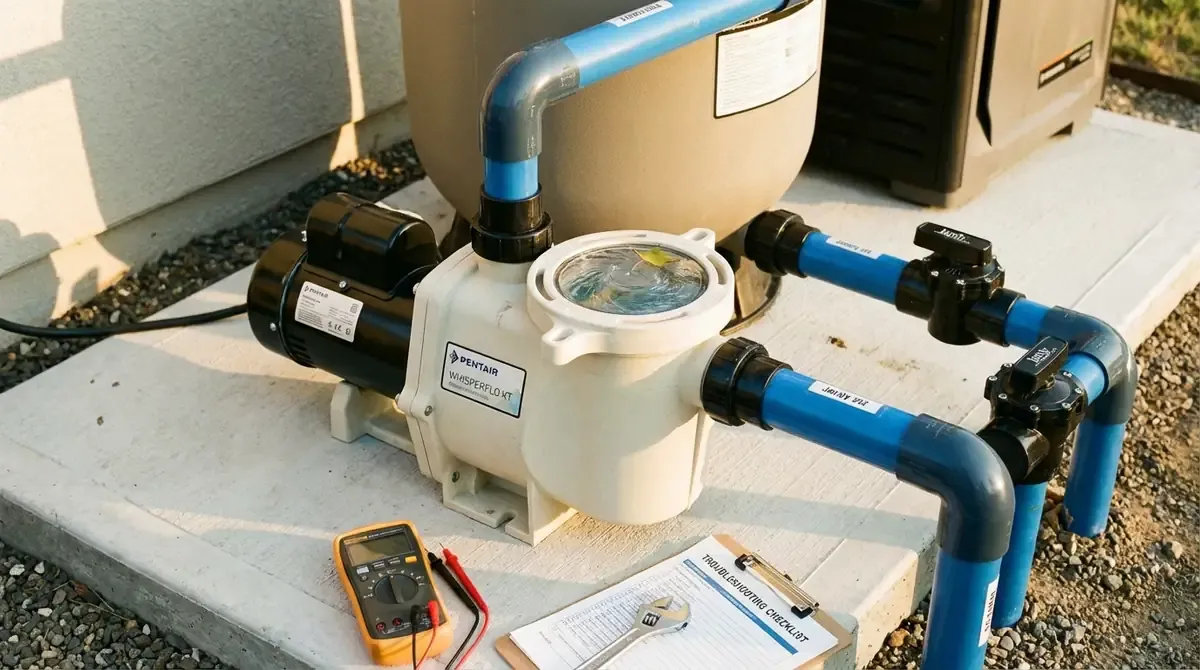
A pool pump basket that stays empty while the pump runs indicates an air leak on the suction side. The pump motor is working correctly, the problem is that suction cannot build because air is entering the intake.
What normal looks like: When properly primed, the pump basket is full of water and pressure reads 8-25 PSI. A reading of 0 with an empty basket means the pump is spinning without water, a situation that should not run for more than 2-3 minutes to avoid seal damage.
Is Your Pump Running But No Water Moving?
Confirm which symptom you have before proceeding:
- Basket stays empty, gauge at 0: The pump never primed, the subject of this guide
- Basket fills briefly then empties: The pump primes and loses suction, still an air leak, but intermittent
- Basket is half full: Active air leak, the pump is pulling some water but air is also entering
- Pump is completely silent: Power or motor problem, not a priming issue, see pool pump troubleshooting guide
A pump basket that is only half-full while the pump runs indicates an active air leak on the suction side.
Pressure gauge reading 0 when the pump is running means no prime. Normal operating pressure is 8-25 PSI, below that, the pump is not moving water.
This guide is for you if / this guide is NOT for you if
This guide is for you if:
- Your pump runs but the basket stays empty
- The pump primes briefly then loses suction
- You recently opened the pool or did equipment repairs and now can’t get prime
- You’ve already tried re-priming but it won’t hold
This guide is NOT for you if:
- The pump is completely silent (no hum at all), see pool pump problems
- You need the priming procedure itself (filling the basket, bleeding air)
- Your pump primes fine but makes strange sounds
The 6 most common causes of prime failure
Based on what we see in service calls and community reports, we recommend working through these in sequence, easiest to most involved:
- Low pool water level (free fix, 30 minutes)
- Clogged skimmer or pump basket (free fix, 10 minutes)
- Failed basket lid O-ring (cheap fix: $3-$8)
- Air leak on suction line (requires shaving cream test)
- Closed or partially closed valve (free fix, forgotten after winterizing)
- Clogged or failed impeller (moderate DIY or pro)
Video guide
Video: “How To Troubleshoot a Pool Pump That Is Not Fully Priming” by Inyo Pools
Cause 1: low pool water level
The water level in your pool must be above the middle of the skimmer opening. When the water drops below the skimmer throat, the skimmer starts drawing air instead of water, and the pump can’t build suction.
How to check: Look at the skimmer opening on the pool wall. Water should reach at least halfway up the opening. If you can see the bottom of the skimmer opening exposed, the level is too low.
Fix: Add water with a garden hose until the level is mid-skimmer or slightly above. Takes 20-30 minutes. Then try priming again.
If you’re having trouble getting the skimmer drawing properly even with adequate water level, a skimmer not drawing water problem may be involved.
Cause 2: clogged baskets
Both the skimmer basket (in the pool wall) and the pump basket (inside the pump housing) must be clear. Even a partially clogged basket restricts flow enough to prevent priming.
Clogged baskets restrict flow even when the pump is running, the restriction creates back pressure that prevents suction from building.
How to check: Turn the pump off, remove both the skimmer basket and pump basket, and inspect them.
Fix: Rinse both baskets with a garden hose. Remove any leaves, hair, or debris. Reinstall and try again.
Pro tip: If the pump basket was dry when you opened it, that confirms the pump never primed before you turned it off. If it was wet, the pump had primed at some point and lost suction later.
Cause 3: failed basket lid O-ring (most common non-obvious cause)
The basket lid O-ring seals the lid where it threads onto the pump housing. If this O-ring is dry, cracked, flattened, or missing, air enters at the lid seam and breaks suction.
The basket lid O-ring is the most overlooked cause of pool pump prime failure. A cracked or dry O-ring allows air to enter at the lid seam, preventing the pump from building suction regardless of how much water you add to the basket.
Even a tiny air gap at the lid is enough to prevent priming. The physics: the pump creates a partial vacuum to draw water. Any air path into that vacuum, even a hairline gap, eliminates the pressure differential the pump needs.
How to identify: Wet your hand and run it around the lid rim while the pump is running. If you feel suction pulling your hand, air is entering there. You may also see small bubbles appearing at the lid seam.
Fix:
- Turn off the pump
- Remove the lid
- Inspect the O-ring in the groove, look for cracks, flat spots, or a dried-out surface
- Apply Magic Lube (or Teflon-compatible lubricant) to the O-ring
- If the O-ring is cracked or deformed, replace it. O-rings cost $3-$8 at any pool supply store
For more detail, the INYOPools priming troubleshooting{:target=“_blank”} guide includes O-ring inspection steps.
Cause 4: air leak on suction line
The suction side of your system runs from the pool and skimmer, through underground and above-ground pipe, to the pump inlet. Any crack, loose fitting, or degraded O-ring anywhere on this path lets air in and prevents priming.
This is the most common cause of persistent prime failure, the kind that won’t hold even after you fill the basket and get momentary prime.
Where air leaks most commonly occur:
- Union fitting O-rings at the pump inlet
- Skimmer lid gasket (above-ground on the pool deck)
- PVC pipe joints that have separated or cracked
- Any valve body on the suction line
How to find it, the shaving cream test: With the pump running, spray aerosol shaving cream on each fitting and joint on the suction side. Watch for foam disappearing into a fitting, that is your leak point. The pump’s suction pulls the foam in wherever there’s a gap.
Fix depends on location:
- O-ring at union fitting: $5-$15 for replacement O-ring
- Skimmer lid gasket: $5-$20
- PVC pipe joint that separated: $20-$60 for pipe repair
If you’re finding air bubbles in your pool return jets along with the priming failure, see our guide on air bubbles in pool jets, it walks through the shaving cream test procedure in detail.
For community discussion on suction leaks, TroubleFreePool community advice{:target=“_blank”} covers many real-world cases.
If you also notice a pool pump water leak at fittings around the pump, the same fitting O-rings that cause water leaks when pressure is off can cause air leaks when suction is present.
Cause 5: closed or partially closed valve
After winterizing a pool, doing filter maintenance, or completing equipment repairs, it is easy to leave a suction-side valve closed or only partially open. A partially open valve restricts flow to the point where the pump cannot prime.
Where to check: Ball valves and gate valves on the suction lines between the pool and the pump. Look for any valve that is not in the fully open (fully counterclockwise) position.
Fix: Turn each valve fully counterclockwise to open. Then try priming.
This is especially worth checking after pool opening, see the pool opening checklist for a reminder on valve positions during spring startup.
Cause 6: clogged or failed impeller
The impeller is a spinning disc inside the pump body that creates the suction. Debris (leaf fragments, pebbles, hair) can get past the baskets and jam the impeller.
Signs of an impeller clog:
- Pump runs and makes normal sound, but no flow despite no visible air leak
- Pump body gets hot (restricted flow means no cooling water)
- Low amperage draw compared to motor label specs
- High filter pressure alongside low suction flow
How to check without disassembly: With the pump off, try to turn the impeller by hand through the drain plug opening. If you can reach it and it won’t spin freely, there’s debris.
Clearing the impeller: Requires disassembly, removing the pump body/volute from the motor, then using a long screwdriver or wire hook to pull debris from the impeller vanes. This is a moderate DIY job (30-45 minutes).
Impeller replacement: If the impeller is cracked or broken, replacement costs $20-$80 depending on pump model.
When to Call a Pro
Stop DIY and call a pool professional for:
- Underground suction line crack: You find an air leak but can’t locate it above ground. Underground pipe requires a pressure test to locate and excavation to repair.
- Cracked skimmer body: If the skimmer itself is cracked (not just the lid), repair involves the pool deck and concrete, not a DIY fix.
- Impeller replacement on an older pump: If you disassemble the pump and find the impeller needs replacement on a motor that’s 8+ years old, the repair cost often approaches a full pump replacement. Worth getting a quote on both.
FAQ
How long should it take a pool pump to prime?
A pool pump should prime within 30-60 seconds of starting. If the basket is not filling with water within 2-3 minutes, turn the pump off and investigate. Running a pump dry for more than a few minutes can damage the shaft seal and motor bearings.
Why does my pool pump lose prime overnight?
Overnight prime loss almost always indicates a small air leak that the pump can overcome when it first starts, but can’t maintain. The pump primes against the small air leak initially, but as suction lowers the water level at the pump, the air leak eventually outcompetes the suction. The culprits are usually the basket lid O-ring, union fitting O-rings, or a check valve that leaks back.
Can a dirty filter cause a pump not to prime?
A dirty filter causes high pressure on the return side (high PSI reading), not a priming problem. Prime failure shows as 0 PSI on the gauge. If your gauge reads high instead of zero, see our pool pump troubleshooting guide, you likely have a filter issue, not a suction problem.
What does it mean when my pool pump basket is only half full?
A half-full basket confirms an active air leak on the suction side. The pump is drawing some water but also sucking in air through a gap somewhere. The most common causes are: lid O-ring gap, loose union fitting, or low pool water level. Work through Causes 1-4 above to find it. For Hayward pump support{:target=“_blank”} on specific models, Hayward’s support site has brand-specific guidance.