Pool Pump Keeps Losing Prime: What’s Causing It and How to Stop It
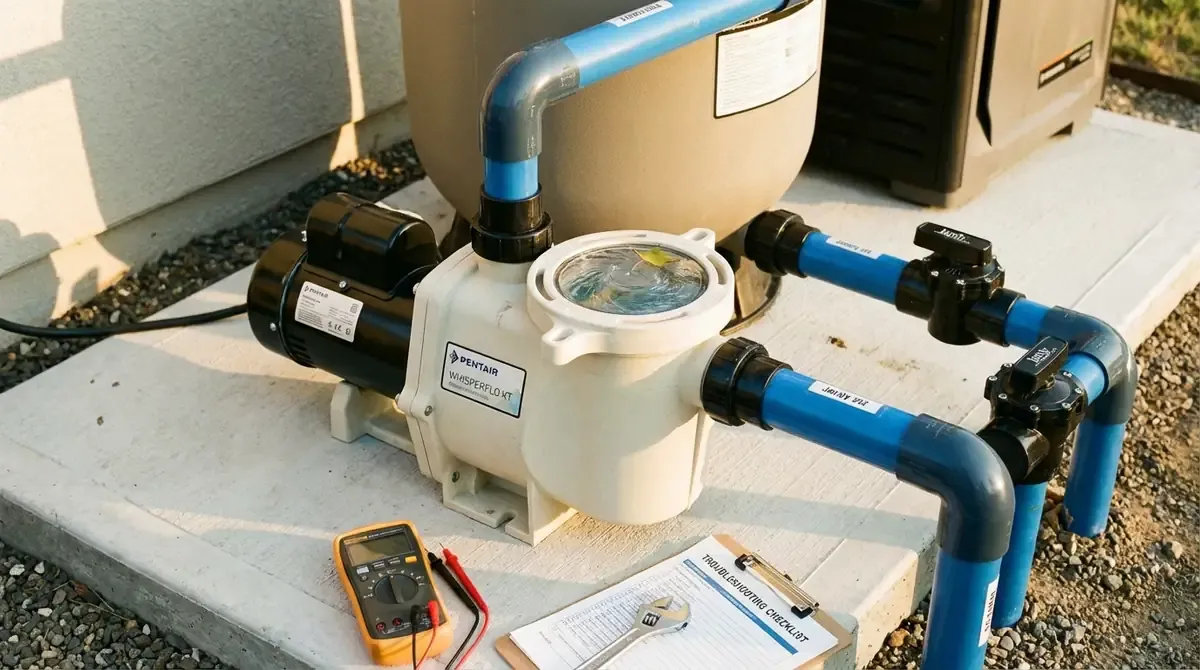
A pool pump that loses prime during operation, rather than failing to prime at startup, has a small air leak on the suction side. The initial suction is strong enough to overcome the gap, but the pump cannot maintain the tight seal needed for continuous flow. We cover the four specific causes of intermittent prime loss below, how to tell them apart, and what each fix actually costs.
Losing prime vs. not priming: the key difference
These are two different problems with different root causes.
Not priming means the pump never builds suction even after you fill the basket manually. The basket stays empty immediately after startup. This indicates a large air entry point or blockage. That problem is covered in our pool pump not priming at all guide.
Losing prime means the pump starts correctly, builds suction, runs for minutes or hours, then the basket gradually empties and flow drops. Re-priming fixes it temporarily, but the problem returns. This pattern points to a slow, intermittent leak, one that the pump’s initial suction pressure can seal, but cannot maintain at steady-state operating pressure.
The losing-prime pattern is harder to diagnose because the leak may be invisible at startup. Small air leaks can seal briefly under the pump’s high initial draw, then gradually let air in as suction pressure equalizes during operation.
This guide is for you if… / this guide is NOT for you if…
This guide is for you if:
- Your pump primes at startup and runs correctly at first
- Prime is lost after minutes or hours of operation
- You need to re-prime frequently (daily or weekly)
- The pump basket empties during or after operation
This guide is NOT for you if:
- Your pump never primes at all (see pool pump not priming at all)
- Your pump won’t turn on or hums but doesn’t start (see pool pump troubleshooting)
- Your pump is leaking water visibly (see pump leaking water)
The 4 most common causes of intermittent prime loss
- Slow suction-side air leak, the most common cause. A small crack or loose fitting that the pump’s startup suction can overcome, but cannot maintain during steady operation.
- Water level dropping during operation, evaporation, splash-out, or an active pool leak causes the water level to dip below the skimmer inlet, letting air in gradually.
- Check valve failure on elevated systems, a one-way valve that holds water in the suction line when the pump shuts off. Failed check valves drain the pump pot completely, requiring re-prime every startup.
- Basket lid O-ring seating issue, an O-ring that seals at startup but shifts or loosens as the pump warms, creating a slow air entry point.
Video guide
Video: “How To Troubleshoot a Pool Pump That Is Not Fully Priming” by Inyo Pools
Cause 1: slow suction-side air leak
This is the hardest cause to find and the most common. Small cracks or loose fittings only partially open, the pump’s initial suction draws them shut, so the pump primes fine. As the system reaches steady-state pressure, the seal relaxes and air enters slowly.
Where to look:
- Union fitting O-rings on the suction line, especially the fitting closest to the pump inlet
- Skimmer body hairline cracks (hard to see without direct light and dried surface)
- Skimmer lid gasket, if the lid doesn’t seat evenly, it pulls in air at operating pressure
- Suction line fittings at elbows or tees
The shaving cream test: Apply foam shaving cream to each suction fitting while the pump is running. Watch for the foam to disappear or get sucked in at a specific point, that is the leak location. Run this test 15 minutes into pump operation, not just at startup. Small leaks may seal initially and only appear once the pump has been running. MrPoolMan specifically recommends the shaving cream test as the primary diagnostic for this cause, and the TroubleFreePool prime loss discussion{:target=“_blank”} confirms air entry as the leading cause in these cases.
Sometimes the leak only appears when fittings expand thermally, run the shaving cream test on a warm afternoon if the prime loss pattern is worse in summer.
Fix: Replace union O-rings ($5-$15). Repair skimmer hairline cracks with two-part epoxy pool putty ($10-$30, applied to a dry surface). Re-glue or replace fittings that are cracked at joints.
Cause 2: water level dropping during operation
Pool water evaporates at roughly 1/4 to 1/2 inch per week in summer. Add splash-out from active use and that rate goes higher. As the water level drops below the skimmer throat, the skimmer begins to pull in air. This shows up as prime loss that occurs late in a pump cycle, after the pump has run several hours on a hot afternoon.
Symptom pattern: Prime loss happens consistently later in the day or after extended pump runs, not at startup.
How to diagnose: Check the water level just before prime loss occurs. If the level is at or below the bottom of the skimmer opening, water level is your cause. If you’re also seeing an unexpectedly fast drop, a pool water leak may be accelerating normal evaporation, a bucket test (filling a bucket to pool level, marking both, checking after 24 hours without the pump running) separates evaporation from an active leak.
Fix: Add water. If an active leak is suspected, locate and repair it. For pool opening prime issues in spring, low water level from winter evaporation is a frequent cause that’s easily missed. During summer, check the water level every few days when temperatures are above 90°F.
If the skimmer is running dry even with adequate water, see our skimmer not working guide for additional skimmer-specific causes.
Cause 3: check valve failure (elevated pump systems)
Check valves are one-way valves installed on the suction line to hold water in the pipe when the pump shuts off. They’re common in systems where the pump sits above the pool, without a check valve, gravity drains the suction line every time the pump stops.
How to identify: If the pump basket empties completely within a few minutes of shutdown, not slowly over hours, but visibly emptying as soon as the motor stops, the check valve has failed. Check valve failure on elevated pump installations causes the pump to lose prime every time it shuts off. The tell: the pump basket empties completely within a few minutes of shutdown, requiring re-priming every startup.
If you need to prime the pump every single morning before it will run, this is the primary suspect.
Fix: Replace the check valve. A standard spring-loaded check valve runs $15-$40. Verify the new valve is installed in the correct flow direction (arrow points toward the pump). Test by watching the pump basket when the pump turns OFF, the basket should remain full for several minutes after shutdown.
Cause 4: basket lid O-ring seating issue
The pump basket lid O-ring may seal correctly when the pump is cold but shift or compress unevenly as the pump warms up during operation. Prime loss that appears consistently after 15-30 minutes of running is a strong signal for this cause.
MrPoolMan identifies the basket lid O-ring as the most overlooked cause of prime loss, it gets less attention than suction line fittings but causes a significant share of intermittent cases.
How to identify: Remove the basket lid. Inspect the O-ring for cracks, flat spots, or debris. Reinstall it with Magic Lube (a silicone-based lubricant compatible with pool equipment). If the O-ring looks intact, try running the pump with the lid pressed firmly by hand while it’s running, if prime holds, the O-ring seating is the problem.
Fix: Replace the O-ring ($3-$8) and apply Magic Lube ($5-$10). This is the cheapest possible repair and worth doing before more involved diagnosis.
Systematic diagnosis approach
We recommend running these checks To avoid disassembling the pump before the simpler causes have been eliminated:
- Check water level at the time prime is lost, not just at startup. If level is at or near the skimmer throat when prime drops, water level is the cause.
- Inspect and re-lubricate the basket lid O-ring, this costs nothing and takes two minutes. If O-ring looks worn, replace it.
- Run the shaving cream test on all suction fittings at 15 minutes into pump operation (not just at startup).
- If elevated system: watch the basket when the pump turns OFF, if basket empties within minutes, check valve is failed.
- If none of the above resolves it: run a bucket test to rule out an active pool water leak that’s dropping the water level faster than normal evaporation.
The INYOPools prime troubleshooting{:target=“_blank”} guide covers additional scenarios if the above steps don’t locate the cause. For general pump issues beyond prime loss, see our full pool pump troubleshooting guide.
FAQ
Why does my pool pump lose prime after it rains?
Rain can deposit leaves and debris into the skimmer basket, partially blocking flow. The restricted flow causes the pump to cavitate and lose prime even with adequate water level. Check and clean the skimmer basket after any significant rain. Cooler temperatures from rain can also cause thermal contraction at fitting joints, temporarily opening gaps that seal again in warmer conditions, making the problem appear intermittent and weather-related.
Why does my pool pump lose prime only in summer?
Two summer-specific factors: evaporation increases to 1/4 to 1/2 inch per week or more in hot weather, dropping water levels faster than the off-season; and thermal expansion of pump housing and fittings can cause O-rings that seal correctly in cooler temperatures to shift slightly in summer heat. Check water level more frequently in summer, and inspect the basket lid O-ring condition in spring before temperatures climb.
Can a dirty pool filter cause prime loss?
No. A dirty or clogged pool filter causes high pressure on the return side, not prime loss on the suction side. A filter that’s at 8-10 PSI above its clean baseline needs cleaning, but this symptom is separate from prime loss. If you have both high pressure and prime loss simultaneously, there are two separate issues to address. Prime loss is always a suction-side problem.
How do I do a pool leak test to rule out a water leak?
The bucket test: fill a 5-gallon bucket with pool water to the same level as the pool. Mark the inside of the bucket and mark the pool wall. Turn the pump off. Check both levels after 24 hours. If the pool loses more water than the bucket, an active leak is pulling water down faster than evaporation alone, and that water loss can eventually drop the pool level below the skimmer. For Hayward pump-specific guidance, see the Hayward pump support{:target=“_blank”} resources.