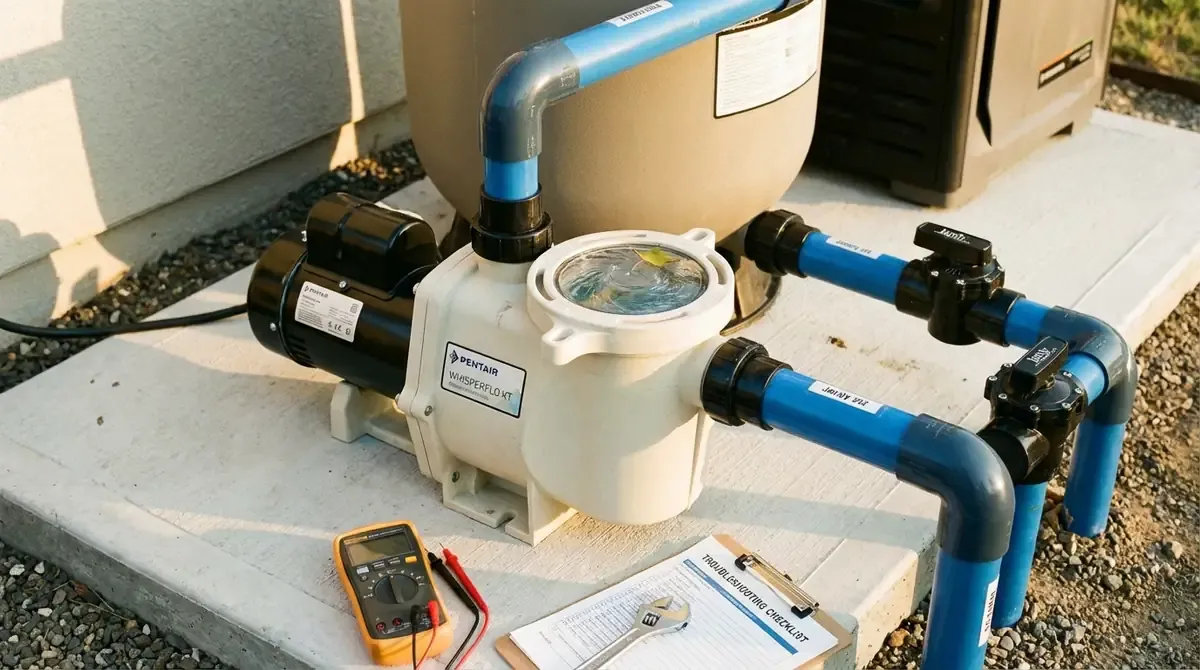
Pool Pump Humming But Not Starting: It’s Probably the Capacitor
A pool pump humming without spinning is one of the most common equipment failures we see. The good news: in about 80% of cases, the cause is a failed start capacitor that costs $15-$40 to replace. We’ll show you how to confirm the diagnosis in a few minutes so you know exactly what to do next.
The most important thing first: turn off the pump immediately. Every attempt to restart a pump that cannot rotate overheats the motor windings. A $15 capacitor problem becomes a $400 motor replacement if you keep trying to force it.
Quick answer: three causes of pump humming
| Cause | Probability | DIY? | Cost |
|---|---|---|---|
| Failed start capacitor | ~80% | Yes | $15-$40 |
| Jammed impeller | ~15% | Yes | $0-$20 |
| Seized bearings | ~5% | No | $80-$150 motor shop |
A pool pump that hums without spinning has a failed start capacitor in approximately 80% of cases. The capacitor provides the electrical jolt needed to start motor rotation. When it fails, the motor receives power but cannot overcome the inertia of the stationary impeller.
This guide is for you if… / this guide is NOT for you if…
This guide is for you if:
- The pump makes a humming or buzzing sound when it tries to start
- The impeller does not spin and no water flows
- The pump turns off or trips its thermal overload after a few seconds of humming
This guide is NOT for you if:
- The pump is completely silent (no hum at all), check our pool pump troubleshooting guide for no-power problems
- The pump starts but no water flows, that is a priming or suction issue, not a capacitor issue
- You hear grinding along with the hum, that is a bearing problem; see pool pump problems for bearing diagnosis
Video guide
Video: “Pool Pump Humming or not starting easy fix!” by Family DIY tv
The start capacitor: why it fails and what to do
The start capacitor gives your pool pump motor a short burst of extra torque at startup. A Capacitor Start motor (the most common type for in-ground pumps) relies on a start capacitor rated 108-300 MFD at 115 VAC to deliver 150-175% of full load torque during the first fraction of a second of operation. A centrifugal switch removes the capacitor from the circuit once the motor reaches about two-thirds of full speed.
When the capacitor fails, the motor receives line voltage but cannot generate enough torque to overcome static friction. The result is the humming sound you hear, the motor is trying to start but cannot.
Visual inspection (fastest diagnosis):
- Turn off the pump at the breaker
- Find the small cover on the motor — either under the hump on top of the motor housing or at the electrical end, held by 2 screws
- Remove the cover
- Look for: a hole in the vent (where electrolytic fluid leaked out), bowing or bulging at the capacitor ends, or oil residue around the base
A hole in the capacitor vent is a definitive failure indicator. No further testing is needed — order a replacement.
Multimeter test (if no visible damage):
Set your multimeter to the lowest ohms (resistance) setting. Touch the probes to the capacitor terminals. A bad capacitor reads 0 and stays at 0. A good capacitor causes the meter to jump and then slowly return toward 0 as the capacitor charges through the meter.
Pool pump start capacitors cost $15-$40. By comparison, motor replacement runs $200-$600. Always check the capacitor before concluding the motor has failed. For full specs, selection rules, and testing detail, see our pool pump capacitor specs and testing guide. For the replacement procedure, see replace the start capacitor for a complete walkthrough.
The TroubleFreePool capacitor reference{:target=“_blank”} has additional technical detail on capacitor types and motor codes.
Jammed impeller (second most common)
If the capacitor tests good but the pump still hums, a debris-jammed impeller is the next most likely cause. This accounts for about 15% of humming pump cases.
The symptom is identical to capacitor failure: the pump hums but the impeller does not spin. The difference is that the motor is fine — something is physically blocking rotation.
How to check:
- Turn off the pump completely at the breaker
- Locate the motor fan cover at the back of the motor (opposite end from the pump wet end)
- Try to rotate the shaft by inserting a flathead screwdriver into the fan slots and turning gently
- The shaft should rotate with moderate resistance — if it will not move at all, or moves only under heavy force, the impeller is jammed
Fix: Disassemble the pump wet end (the front half), remove the debris from the impeller vanes, and reassemble. The impeller itself costs $20-$80 if damaged during the jam. A clogged impeller is usually free to fix if caught before the debris causes physical damage to the vanes.
Seized bearings (rare but serious)
Seized motor bearings account for about 5% of humming pump cases. Unlike the first two causes, this is not a DIY repair.
How to identify: the pump hums AND you hear a grinding or scraping sound when it tries to start, OR the motor shaft will not turn by hand even with the pump wet end removed.
What to do immediately: stop running the pump. Running a seized-bearing motor even for a few seconds generates enough heat to damage the motor windings. The repair bill goes from a $80-$150 bearing repack at a motor shop to a $200-$600 motor replacement if the windings burn.
Take the motor to a local electric motor repair shop for bearing inspection and replacement. Many shops can turn around a pool motor in 24-48 hours.
For a full breakdown of pool pump noise types and what they indicate, see our noise diagnosis guide for more on bearing vs. impeller vs. cavitation sounds.
What to do right now: action plan
Follow this sequence to resolve a humming pool pump:
- Turn off the pump at the breaker — stop the humming immediately
- Locate the capacitor cover — under the hump on top or at the electrical end; remove the 2 screws
- Discharge the capacitor — screwdriver shaft across both terminals
- Visual inspection — look for a hole in the vent, bowing ends, or oil residue
- If capacitor shows physical damage: order a replacement (match MFD and VAC from the old capacitor label) and follow our guide to replace the start capacitor
- If capacitor looks normal: test with a multimeter on ohms setting — stays at 0 = bad; jumps then returns = good
- If capacitor tests good: try rotating the shaft by hand — if it won’t turn, try clearing the impeller or call a motor shop
- If shaft rotates freely and capacitor tests good: consult an electrician about line voltage at the motor terminals
For help ordering the correct capacitor, the INYOPools capacitor replacement{:target=“_blank”} guide has a model-by-model reference table.
FAQ
How much does it cost to fix a humming pool pump?
The cost depends on the cause. A failed start capacitor costs $15-$40 for the part and about 30-45 minutes of your time to replace. If the impeller is jammed and undamaged, the fix is free. A motor shop bearing repack runs $80-$150. Full motor replacement costs $200-$600 depending on horsepower. Always check the capacitor first — it is the least expensive repair and the most common cause.
Can I keep running a pool pump that hums?
No. A pump that hums but cannot spin is drawing full current without the motor rotating. That current has nowhere to go except into heat. The motor windings will overheat within seconds to minutes. Each attempt to restart a seized pump shortens motor life. Turn it off and diagnose before attempting to run again.
Is a humming pool pump dangerous?
The pump itself is not immediately dangerous to people, but continued restart attempts will burn out the motor. The electrical hazard is at the terminal box and capacitor — always turn off the breaker and discharge the capacitor before opening any cover. If you are not comfortable with the inspection steps, pool equipment electrical troubleshooting should be handled by a licensed electrician; see our pool equipment electrical troubleshooting guide for reference.
How long does capacitor replacement take?
A first-time capacitor replacement takes 30-45 minutes. Experienced DIYers can complete it in 15-20 minutes. The job requires a screwdriver, a multimeter for testing, and about $15-$40 for the replacement part. The hardest part is often locating the correct replacement capacitor — use the MFD and VAC rating printed on the old capacitor label, and the motor model number (not the pump housing number) when ordering online.
If you need help identifying pool filter problems that may be related, or want to verify your pump is getting proper flow before testing the motor, check those guides first.
For more help with your pump system, return to our complete pool pump problems guide for a full troubleshooting overview.
For manufacturer support, Hayward pump support{:target=“_blank”} provides motor documentation and capacitor specs for Hayward-brand equipment.