Pool Pump Air Bubbles: How to Find the Air Leak and Fix It
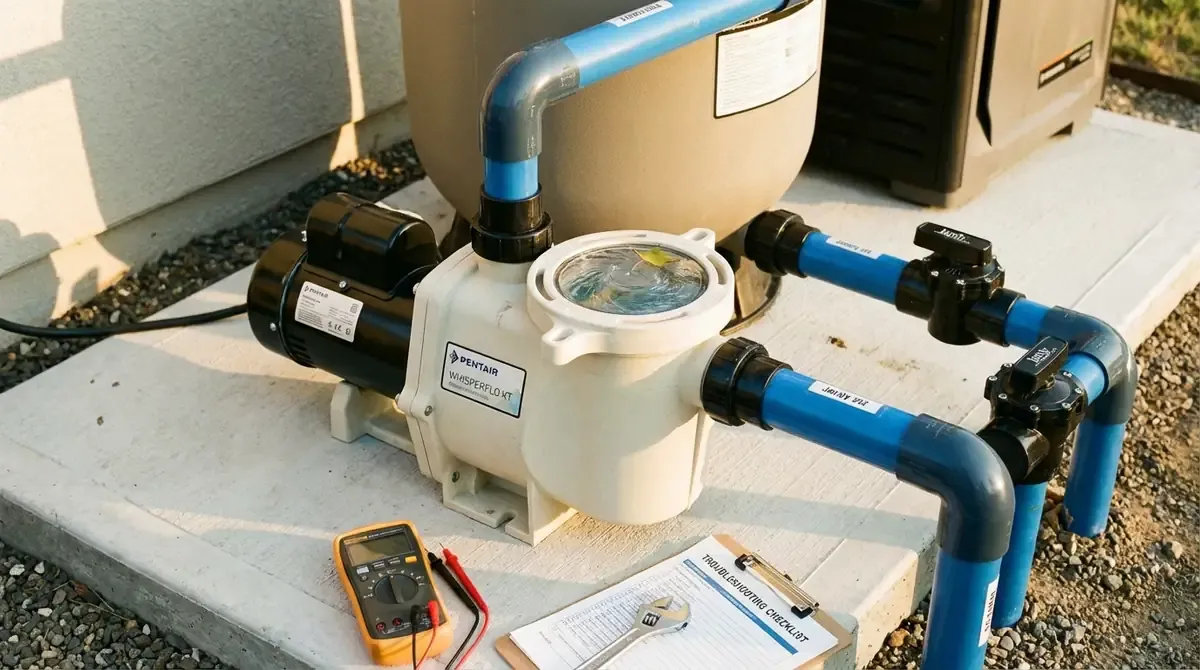
Air bubbles streaming from your pool’s return jets are almost always a sign of an air leak on the suction side of the pump. That means air is sneaking into the system somewhere between the pool and the pump inlet, and the pump is circulating it right back into the water. The fix depends on where the leak is, and the shaving cream test is the fastest way to find it. For a broader look at what else can go wrong, see our pool pump troubleshooting guide.
Video guide
Video: “How To Fix AIR BUBBLES In A POOL” by Swim University
Quick answer: air bubbles come from an air leak on the suction side
Air bubbles in return jets mean air is entering the suction side, the section of plumbing that runs from the pool to the pump inlet. This entire path is under negative pressure (vacuum) while the pump runs, so any gap in fittings, a cracked skimmer, or a degraded O-ring will draw air in.
The three most common causes: low pool water level (free fix), a worn basket lid O-ring (a $3-$8 part), and a loose union fitting. Start with those before investigating further. Check your water level and inspect the pump basket lid first, together these two checks resolve the majority of pool pump air bubble problems without any tools.
This guide is for you if / this guide is NOT for you if
This guide is for you if:
- You see a continuous stream of bubbles from the return jets
- Your pump basket is not staying fully filled while the pump runs
- Air bubbles started after you opened the pool, did a repair, or had a plumber near the equipment pad
This guide is NOT for you if:
- Your pump will not prime at all, read our pool pump not priming guide instead
- You see water dripping at the pump housing, that is a different problem; see our pool pump water leak guide (water coming out is not the same as air going in)
Common causes of pool pump air bubbles (in order)
We find pool owners cycle through these causes in roughly this order of likelihood:
-
Low water level, When the pool drops below the skimmer inlet throat, the skimmer pulls air. Add water to bring the level back to mid-skimmer. Free fix, takes five minutes.
-
Basket lid O-ring, The rubber O-ring around the pump basket lid is the single most overlooked air source. It dries out, cracks, or flattens over time and creates a gap that sucks air on every rotation. According to TroubleFreePool’s community air bubble discussions, this is the cause in a majority of cases where the fix looks obvious in hindsight.
-
Skimmer basket or skimmer housing cracks, A cracked skimmer body can pull air all season. Cracks are often hairline and require close inspection.
-
Union fittings on the suction line, The threaded union connectors at the pump inlet have internal O-rings that degrade. A loose union nut or a worn O-ring draws air.
-
Glued PVC pipe joints, Exposed pipe fittings occasionally crack from UV exposure or ground movement.
-
Multiport valve O-ring, The valve that controls backwash/filter modes has its own internal O-ring. When it fails, air is drawn in through the valve body. Check our guide on multiport valve air leak if this is suspected.
-
Main drain fitting, A loose or cracked drain cover at the bottom of the pool can draw air on the suction return.
The shaving cream test: how to find your air leak
This is the most reliable DIY method for pinpointing a suction-side air leak. The shaving cream test works because the suction side of the pump is under negative pressure, any gap pulls inward, and it will pull shaving cream foam right along with it.
To find an air leak on a pool pump suction line, spray aerosol shaving cream on each fitting while the pump runs. The negative pressure on the suction side pulls foam inward at the leak point, making it disappear, that is your leak location.
Use regular aerosol shaving cream (not gel, gel does not foam the same way). Gel squirted on a tight area is hard to watch. Aerosol foam disappears clearly and fast.
Steps:
- Turn the pump on and let it run 1-2 minutes until flow stabilizes
- Spray aerosol shaving cream on the basket lid seam and O-ring channel
- Move to the union fittings on the suction line, coat each one
- Spray along the skimmer lid and its rubber gasket
- Work down the visible pipe fittings and joints
- Watch carefully: wherever the foam disappears or gets pulled inward is your leak
- Mark the location with chalk or tape before the foam washes away
- Turn off the pump and make the repair
Alternative: A spray bottle of plain water works similarly, puddles form at the leak as water is pulled in. Less dramatic than shaving cream, but functional.
For a complete walkthrough of suction-side leak diagnosis, see INYOPools’ suction side air leak repair guide.
Fix by location
Once the shaving cream test identifies the source, here is how to fix each common location.
Basket lid O-ring
Remove the pump basket lid and inspect the O-ring. Signs it needs replacing: it looks dry and cracked, it has flat spots from compression, or it is missing entirely. Clean the O-ring groove with a damp cloth to remove any grit. Apply Magic Lube (Aladdin brand, Teflon-compatible) to the O-ring before reseating. We never recommend WD-40 on O-rings; it degrades rubber over time. A replacement O-ring from any pool supply store runs $3-$8.
Union fittings
Hand-tighten the union nut first, sometimes it has just loosened. If tightening stops the leak, inspect again next week. If the O-ring inside the union is worn or cracked, remove the union, swap the O-ring ($5-$15), and reassemble. Never use pipe wrenches on PVC union fittings; hand pressure plus one quarter turn is all they need.
Skimmer issues
A failing skimmer lid gasket is a $5-$15 rubber replacement from any pool supply. A cracked skimmer body is a professional repair or skimmer replacement, typically $100-$400 depending on pool type and labor. That said, hairline cracks in the skimmer body sometimes respond to pool putty as a temporary fix while you schedule the proper repair.
PVC pipe cracks
If a glued PVC joint has cracked or separated, it requires cutting out the damaged section and gluing in a replacement fitting. For above-ground pipe, this is a moderate DIY task ($20-$60 in materials). For underground pipe, call a pool plumber.
Normal vs. problem air bubbles
Not every bubble calls for the shaving cream test. Here is how to tell the difference:
Normal:
- Brief bubbles for 1-3 minutes after the pump starts, air in the lines clearing out
- Bubbles after a filter backwash, when air entered during the process
- A few tiny bubbles from one or two return jets during normal operation
Problem:
- Continuous bubbles from the return jets that do not stop after 5 minutes
- Pump basket partially or mostly empty while the pump runs (it should be full)
- A steady, consistent stream from multiple jets
Continuous air bubbles after 5 minutes indicate an active suction leak. That is not normal operation, and running the pump in that state causes wear on the impeller seal over time.
FAQ
Why does my pool have air bubbles only in the morning?
Overnight temperature drops cause PVC fittings and O-rings to contract slightly. A lid O-ring or union fitting that seals adequately at operating temperature may open a small gap when cold. If bubbles disappear after 10-15 minutes of running, inspect the basket lid O-ring first, it is the most likely suspect for thermal gap issues. Check Pentair’s pump maintenance resources for O-ring specifications by model.
Can air bubbles damage my pool pump?
Short-term, a few bubbles cause minimal harm. Long-term, running with a consistent air leak allows the pump to work against a reduced water load, which increases impeller wear and can damage the shaft seal. If the pump runs partially dry, the impeller can be destroyed within a season. Fix air leaks promptly to protect the motor.
How do I get air out of my pool pump?
Prime the pump by manually filling the basket housing with water before starting. Once running, the air should purge within 1-3 minutes. If the basket empties again while running, there is an active air leak on the suction side, locating and fixing that leak is the only permanent solution. Also check for filter pressure issues that can mask air-related symptoms.
What if the shaving cream test doesn’t find anything visible?
Check the multiport valve O-ring, valve body leaks are harder to see with foam because the valve moves internally. Also check the main drain cover at the pool floor; these fittings loosen with pool movement. If neither shows anything, the suction line may have an underground crack. That requires a professional pressure test on the plumbing.
Air bubbles from pool pump return jets are almost always solvable at home. Start with water level and the basket lid O-ring before working through the rest of the suction side. The shaving cream test narrows the search to minutes. For other pump issues beyond air leaks, our pool pump problems guide covers the full troubleshooting sequence.