Pool Heater Troubleshooting: Fix by Symptom
Diagnose your pool heater problem in 60 seconds. Error codes, ignition failures, and runs but no heat — find your fix by symptom. Gas and heat pump covered.
Pool Heater Troubleshooting: Diagnosis Guide by Symptom
A pool heater that stops working mid-summer is one of the most frustrating equipment failures a homeowner faces. Whether your heater is throwing an error code, refusing to ignite, or running without producing any heat, the fastest path to a fix starts with identifying exactly which problem you have. This guide routes you to the right solution page based on your specific symptom, covering both gas heaters and heat pumps. For a broader look at your equipment, start at pool care help.
Is this guide right for you?
This guide is for you if:
- Your pool heater is throwing an error code you do not recognize
- Your heater powers on but produces no heat or weak heat
- Your heater shuts off seconds after starting
- You are not sure what is wrong and need a starting point for diagnosis
This guide is NOT for you if:
- You smell gas near your heater (call your gas company immediately, do not troubleshoot)
- You need a brand-specific walkthrough (see the Raypak, Pentair, or Jandy guides below)
- You are shopping for a new heater or comparing costs (see our pool heater cost breakdown)
- Your pump may also be involved (see pool pump troubleshooting)
Gas vs. heat pump distinction: Gas heaters fail through ignition, gas supply, or heat exchanger problems. Heat pumps fail through refrigerant issues, airflow restrictions, or defrost cycles. The diagnosis paths differ, so knowing your heater type matters before diving in.
Video guide
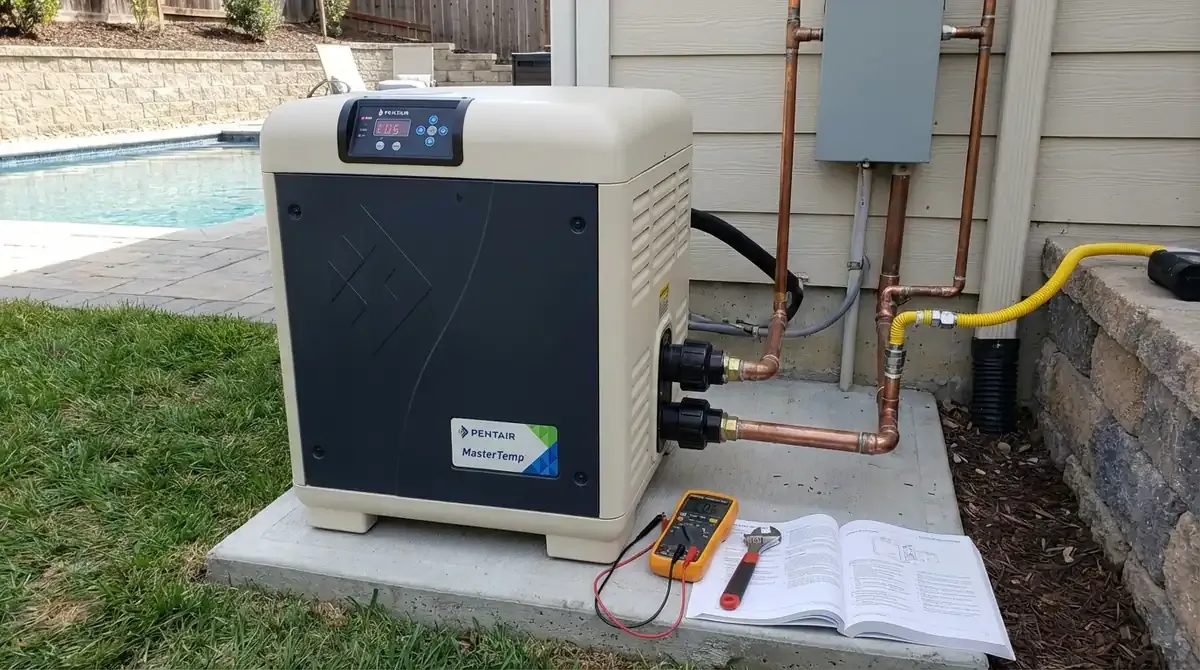
Video: “How to de-bug/fix issues with a Pentair MasterTemp Heater” by Craig Wooster
Start here: diagnose your heater problem
Use this table to find your symptom and go directly to the right page:
| Symptom | Most likely cause | Go here |
|---|---|---|
| No display, no response, no ignition attempt | Power, thermostat, or flow switch | Pool heater won’t turn on |
| Heater fires but water stays cold | Heat exchanger or flow issue | Pool heater running but no heat |
| Heater clicks, attempts to light, no flame | Gas supply or igniter failure | Pool heater ignition failure |
| Error code on the display panel | Brand-specific fault | Raypak / Pentair / Jandy sections below |
| Heater starts then shuts off within minutes | High limit switch tripped (low flow) | Pool heater running but no heat |
Two quick resets to try first:
- Ignition lockout reset: power the heater off for 30-60 seconds, then back on. Most heaters lock out after 3 failed ignition attempts and need this manual reset.
- High limit trip: if your heater shuts off shortly after starting, the most common cause is insufficient water flow triggering the high limit switch. Check your filter pressure and verify the pump is running before calling a tech.
If your pump may also be contributing to the problem, see pool pump troubleshooting or check pump not turning on as a starting point.
Understanding pool heater error codes
Error codes are your heater’s fastest communication channel. Here is what the three major brands are telling you:
Raypak error codes
| Code | Meaning | Common fix |
|---|---|---|
| E1 / HI LIMIT | High limit sensor tripped (water too hot or sensor failure) | Check water flow; clean filter |
| E2 / OUTLET SENSOR | Outlet temperature sensor failure | Sensor replacement |
| E3 / INLET SENSOR | Inlet temperature sensor failure | Sensor replacement |
| IGN FAIL / IF | Ignition failure at burner | Check gas supply; clean igniter |
See our dedicated Raypak pool heater troubleshooting guide for full repair steps.
Pentair MasterTemp and max-E-therm error codes
| Code | Meaning | Common fix |
|---|---|---|
| E01 | Stack flue sensor open | Sensor or wiring fault |
| BO | Bypass open (flow issue) | Check bypass valve and filter |
| PS | Pressure switch error (insufficient flow) | Filter, pump, or plumbing issue |
| HLS | High limit switch tripped | Increase flow rate; check pump |
For more detail on each code, see Pentair heater troubleshooting resources{:target=“_blank”} or our Pentair pool heater troubleshooting guide.
Jandy LXi and hi-E2 error codes
| Code | Meaning | Common fix |
|---|---|---|
| E01 | Thermal regulator fault | Sensor or board issue |
| E04 | High limit tripped | Check water flow and temperature |
| E06 | Ignition lockout (3 failed ignition attempts) | Reset power; inspect igniter |
See our Jandy pool heater troubleshooting guide for brand-specific repair steps.
Pool heater not turning on
Best for: Your heater shows no signs of life at all: no display, no ignition attempt, no fan noise.
Four quick checks before calling a technician:
- Power supply: Verify the circuit breaker for the heater has not tripped
- Thermostat set point: The heater setpoint must be higher than the current water temperature to activate
- Flow switch: The heater requires a minimum flow rate to close the safety flow switch and allow ignition
- Gas supply: Confirm the gas shutoff valve at the heater is fully open
If none of these reveal the problem, the pool heater won’t turn on guide walks through the full diagnostic sequence, including control board tests and wiring checks.
Pool heater ignition failure
Best for: The heater powers up and you can hear clicking or see an ignition attempt, but no flame appears.
The four most common causes of ignition failure are:
- Gas supply interruption (check shutoff valve and verify other gas appliances in your home work)
- Dirty or corroded igniter electrode
- Failed thermopile or thermocouple
- Gas valve not opening (mechanical or electrical fault)
Safe reset to try first: Turn power off for 30-60 seconds. Most heaters lock out after 3 failed ignition attempts. This reset clears the lockout without needing a technician.
See our dedicated ignition failure troubleshooting guide for step-by-step diagnosis of each cause.
Taboo: If the ignition problem is tied to a gas line connection issue (smell of gas, suspected leak, loose fitting at the meter or supply line), do not attempt any repairs. Contact a licensed plumber. This is a safety requirement, not a preference.
Pool heater maintenance to prevent problems
We find that most heater failures we see are preventable with consistent seasonal care. A well-maintained heater should last 7-10 years for gas models and 5-10 years for heat pumps.
The two factors that shorten heater life the most are ignored by most maintenance guides:
- Low pH (below 7.2) corrodes the heat exchanger, which is the most expensive component to replace at $500-$800+ in parts alone
- High pH (above 7.8) causes calcium scale that blocks heat transfer and stresses the combustion system
Maintaining pH at 7.4-7.6 and calcium hardness at 200-400 ppm protects your heater more than any mechanical maintenance step. For the full seasonal schedule, see our pool heater maintenance checklist.
When to repair vs. replace
We recommend using the 50% rule: if repair cost exceeds 50% of the replacement cost on a heater that is 7 or more years old, replacement is almost always the better investment.
Here is where specific repair costs land relative to that threshold:
| Repair | Parts cost | Labor estimate | Repair worth it? |
|---|---|---|---|
| Igniter replacement | $50-$150 | $100-$200 | Yes, nearly always |
| Circuit board | $150-$300 | $100-$200 | Depends on heater age |
| Heat exchanger | $500-$800+ | $200-$400 | Rarely on 7+ year units |
For help budgeting a new unit, see pool heater cost for full purchase, installation, and operating cost breakdowns. For ENERGY STAR pool equipment ratings{:target=“_blank”}, the DOE database lists efficiency ratings by brand and model.
Explore heater types
Not all heaters fail the same way, and the right replacement depends on your climate, pool size, and usage patterns.
Gas heaters heat water quickly regardless of air temperature. They are the dominant choice for pools in colder climates or pools used infrequently. A 400,000 BTU gas heater can raise pool temperature by 1-2 degrees per hour.
Heat pumps extract heat from ambient air rather than burning gas. They cost more upfront ($1,500-$4,000) but run at 60-70% lower cost per season in warm climates. See our pool heat pump guide for a complete comparison.
Solar heating adds a low-cost, zero-operating-cost option that extends your swim season by 4-6 weeks in most climates. See solar pool heater for DIY vs. professional installation options.
FAQ
How do I reset my pool heater?
Most pool heaters reset by turning the power off for 30-60 seconds, then switching it back on. This clears ignition lockouts that occur after 3 failed attempts. If the heater continues locking out after reset, the underlying cause (gas supply, dirty igniter, or failed gas valve) needs to be addressed before the reset will hold.
Why does my pool heater keep shutting off?
The most common cause of a pool heater shutting off unexpectedly is a tripped high-limit switch caused by insufficient water flow through the heater. Check your filter pressure (a dirty filter reduces flow), verify the pump is running at the correct speed, and confirm the bypass valve is in the correct position. If flow checks out, a faulty high-limit sensor or control board may be the issue.
Can I fix a pool heater myself?
Many pool heater repairs are DIY-friendly: igniter cleaning or replacement ($50-$150 in parts), sensor replacement, reset procedures, and water chemistry corrections. What you should not do yourself: gas line connections, pressure testing gas supply, or any work on the gas valve or burner manifold. Those tasks require a licensed plumber or gas fitter.
How long do pool heaters last?
Pool heaters typically last 7-10 years for gas models and 5-10 years for heat pumps, depending on water chemistry and annual maintenance. Heaters running in pools with chronically low pH (below 7.2) often fail at 3-5 years due to accelerated heat exchanger corrosion. Annual professional service extends both lifespan and warranty coverage.
What temperature should a pool heater be set to?
Most residential pools are heated to 78-82 degrees Fahrenheit. Competitive swimmers prefer 77-79 degrees, while recreational swimmers and families with children typically prefer 80-82 degrees. Hot tubs and spas are usually set to 100-104 degrees. Setting your heater higher than needed wastes fuel without meaningfully improving comfort.