Pool Heater Runs But Not Heating: 6 Causes and Fixes
When a pool heater runs but the water doesn’t warm, short cycling is the most likely culprit. If the heater runs for only 2-5 minutes before shutting off, inadequate water flow is tripping the high-limit safety switch, the fix is to clean the pool filter. But if the heater runs continuously without raising water temperature, the cause is different: a scaled heat exchanger, undersized BTU output, or low gas pressure. We cover all six scenarios below. For a broader overview, see the pool heater troubleshooting guide.
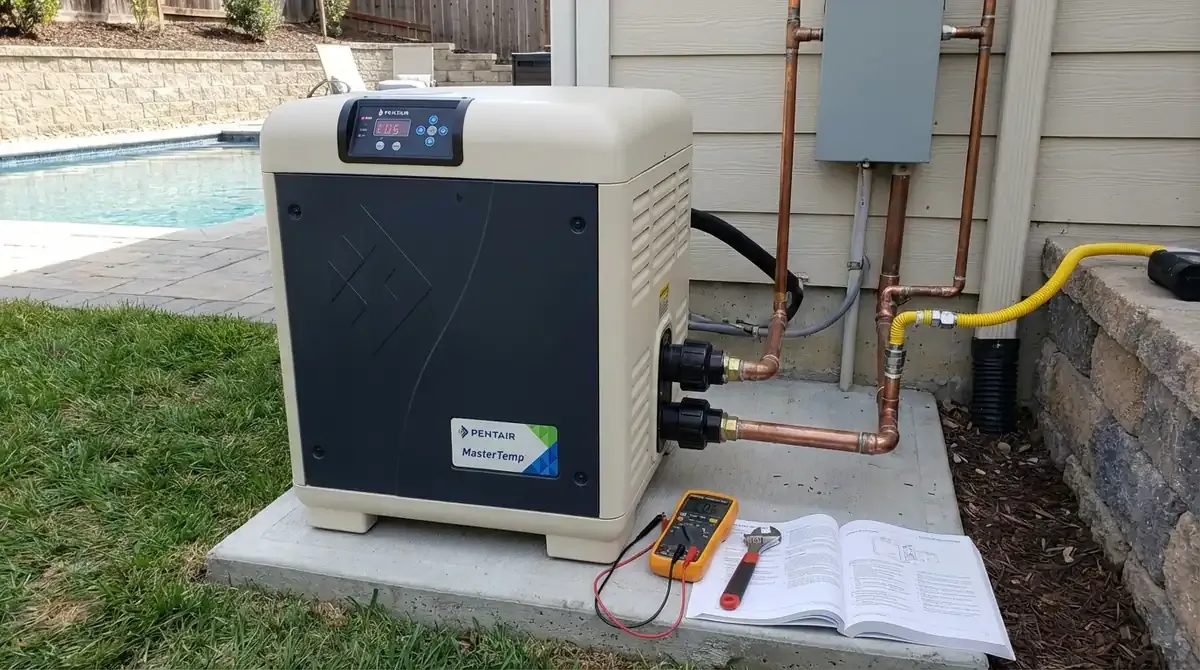
Video guide
Video: “Pentair pool heater turns on but does not heat” by Jack of All Trades
Is this guide right for you?
This guide is for you if:
- Your pool heater turns on and runs, but the water stays cold or never reaches set temperature
- Your heater cycles on and off repeatedly without building water temperature
This guide is NOT for you if:
- Your heater won’t turn on at all, see pool heater won’t turn on at all
- Your heater shows an error code, see the Raypak, Pentair, or Jandy brand guides
- Your heater is brand new and you’re unsure how long heating should take, read the expectations section below first
Quick answer: why is the heater running but pool water stays cold?
When a heater runs but doesn’t heat: the most likely causes are short cycling from thermostat setpoint or flow restriction, a dirty filter reducing circulation, a scaled heat exchanger from poor water chemistry, or a heater undersized for the pool. First check whether the heater is actually short cycling. If it runs for only 2-3 minutes before shutting off, the problem is flow, not the heater’s heat output.
Before you diagnose: realistic heat-up rate expectations
Many “pool heater not heating” searches lead to working heaters. A properly sized gas pool heater raises water temperature at roughly 1-2°F per hour. A 15,000-gallon pool that is 10°F below set temperature requires 10-20 hours of continuous heating to reach target. This is normal operation, not a failure.
Heater size also matters. A 200,000 BTU heater heats faster than a 100,000 BTU heater running on the same pool. If your heater has been running for less than 6 hours and the water hasn’t warmed, that may be normal, check actual BTU output versus pool volume before diagnosing a failure.
Cause 1: short cycling (heater turns off before heating pool)
Short cycling is the most common “running but not heating” scenario. The heater fires, runs for 2-5 minutes, shuts off, and the cycle repeats, but pool temperature never climbs.
Root cause: Inadequate water flow trips the high-limit safety switch. The switch detects that temperature inside the heat exchanger is rising too fast (because not enough cool water is moving through to carry heat away), and shuts the heater down as a protection measure.
Diagnosis: Check your filter pressure gauge. If it reads more than 8-10 PSI above your clean baseline, the filter needs cleaning. According to Pentair heater flow requirements documentation{:target=“_blank”}, Pentair heaters require a minimum flow rate to maintain safe operation. A clogged filter drops that flow below the threshold.
Other causes of short cycling:
- Closed bypass valve on the heater itself
- Pool pump running at low speed (variable-speed pump set too low)
- Skimmer basket or pump basket packed with debris
Fix: Clean the filter, verify the bypass valve is fully open, and confirm the pump is running at full speed. Restart the heater. If it now runs continuously, flow was the problem.
See our guide on low water flow from pump if the pump itself seems to be the issue, or dirty filter causing low flow for filter cleaning procedures.
Cause 2: scaled or corroded heat exchanger
This is the cause competitors most often miss. The heat exchanger is the core component that transfers heat from the burner to the pool water. When it’s coated with calcium scale, it acts as an insulator, the heater produces heat, but the scale prevents efficient transfer to the water.
How scaling happens: High pH (above 7.8) causes calcium carbonate to precipitate out of solution and deposit on the heat exchanger. A heater that runs hot and slow is a perfect scaling environment.
How corrosion happens: Low pH (below 7.2) corrodes the metal of the heat exchanger over time, eventually causing micro-cracks that leak combustion exhaust into the pool side.
Diagnosis: Test your water chemistry. The relevant numbers:
- pH should be 7.4-7.6 for heater longevity
- Calcium hardness (CH) should be 200-400 ppm
Calcium scale on a pool heater’s heat exchanger acts as an insulator, reducing heat transfer efficiency. Maintaining pH between 7.4-7.6 and calcium hardness between 200-400 ppm prevents scale from forming.
If pH and CH have been out of range for an extended period, suspect scale buildup.
Fix: Acid wash of the heat exchanger, which requires professional service and disassembly. Do not attempt a DIY acid wash on a gas heater’s heat exchanger. The risk of improper reassembly or damage to seals is significant.
Prevention: Maintain pH 7.4-7.6 and CH 200-400 ppm consistently. Run the heater at its rated flow rate, heat exchangers that operate below minimum flow overheat locally and scale faster. See our guide on heat exchanger maintenance for the annual service checklist.
Cause 3: heater undersized for pool volume
If the heater runs continuously at full output and the water temperature barely moves, the unit may simply be too small for the pool.
BTU sizing rule of thumb: 50,000 BTU per 10,000 gallons as a baseline in warm climates. Factors that increase BTU need: significant shading, high wind exposure, low ambient nighttime temperatures, and large gaps in the pool cover.
Example: A 20,000-gallon pool needs at least 100,000 BTU of heater output in a moderate climate. A 100,000 BTU unit on a 30,000-gallon pool will heat very slowly.
Fix: An undersized heater is not broken. Options are: accept slower heating, reduce heat loss with a good pool cover (covers reduce heat loss by 50-70%), or upgrade to a higher BTU unit. See our guide on heater repair vs replacement cost if you’re evaluating an upgrade.
Cause 4: gas pressure or supply issue
Lower gas pressure reduces BTU output. The heater fires and runs, but produces less heat than its rated output because the burner isn’t getting sufficient gas pressure to operate at full capacity.
Signs: The heater fires, but the flame looks weak or smaller than normal if you can see the burner through an inspection port. Water temperature rises very slowly even during prolonged runs.
Diagnosis: If neighbors on the same gas line are experiencing lower hot water output or other gas appliance issues, it may be a utility supply problem.
Fix: Contact your gas utility. Gas pressure is their responsibility to maintain at the meter. Do not attempt to adjust the gas pressure regulator yourself, this requires a licensed gas technician and incorrect adjustment can cause unsafe combustion conditions.
What to do if none of these fix it
If the heater short cycles after filter cleaning, or runs continuously without heating, professional diagnosis covers:
- Combustion efficiency test (burner output at rated BTU)
- Heat exchanger inspection for cracks, scale, or corrosion
- Gas pressure verification at the manifold
Heat exchanger failure: If the heat exchanger is cracked, the heater will run and appear to operate normally, but combustion gases bypass the pool water side. Heat escapes into the exhaust stack rather than transferring to the water. This is a dangerous failure mode in addition to an inefficient one.
Heat exchanger replacement costs $500-$800 or more in parts alone. For units 7 years old or older, we recommend getting a replacement quote alongside the repair estimate before committing. See Raypak heater support documentation{:target=“_blank”} for model-specific heat exchanger compatibility if you’re sourcing parts.
For a broader cost analysis, see our pool heater troubleshooting guide and consider the DOE pool heater efficiency and sizing guide{:target=“_blank”} when evaluating replacement options.
FAQ
Why does my pool heater keep shutting off?
A pool heater that repeatedly shuts off is almost always experiencing inadequate water flow. The high-limit switch detects that heat is building up inside the heat exchanger faster than the water flow can remove it, and shuts the unit down to prevent damage. Check filter pressure first (if it’s 8-10 PSI above baseline, clean the filter), then check that the bypass valve is open and the pump is running at full speed. A heater that trips the high-limit switch continuously even with good flow needs a professional inspection.
How long should it take a pool heater to heat a pool?
A properly sized gas pool heater raises water temperature at roughly 1-2°F per hour. A 15,000-gallon pool that is 10°F below set temperature requires 10-20 hours of continuous heating to reach target. Larger pools or underpowered heaters take proportionally longer. If your heater has been running for less than 6-8 hours and the pool hasn’t warmed to target, that is within normal range for most pool sizes.
Can a dirty filter cause a pool heater to not heat?
Yes. A dirty pool filter reduces water flow through the heater’s heat exchanger. When flow drops below the heater’s minimum threshold, the high-limit safety switch trips and the heater shuts off after a few minutes of running, a pattern called short cycling. Clean the filter and the heater will typically run normally. If the heater still short-cycles after filter cleaning, check the bypass valve position and pump speed.
What causes a pool heater heat exchanger to fail?
Heat exchanger failure has two main causes: corrosion from chronically low pH (below 7.2), which eats through the metal over time; and scale buildup from high pH or high calcium hardness, which blocks heat transfer. Mechanical failures (cracks from freeze-thaw cycling in cold climates, or stress fractures from running with inadequate flow) can also occur. Annual professional service that includes a heat exchanger inspection catches scaling and early corrosion before they progress to full failure.
How do I know if my pool heater heat exchanger is bad?
Signs of heat exchanger failure: the heater runs normally but the pool never warms (heat escaping into exhaust rather than water); white or green scaling visible on external connections; combustion odor near the pool return jets; or a pool that requires unusually high levels of chemical treatment (a cracked heat exchanger can allow combustion byproducts to enter the water). A technician can confirm failure with a combustion analysis and disassembly inspection. Heat exchanger replacement costs $500-$800 in parts.