Pool Heat Pump: How It Works, True Costs, and Best Models (2026)
A pool heat pump with a COP of 6.0 produces $6 of heat energy for every $1 of electricity consumed, making it 3-4x more efficient to operate than a gas heater in warm climates. The catch: they cost more upfront ($2,500-$5,000 installed vs $1,500-$3,500 for gas), and their efficiency drops sharply when outdoor air temperatures fall below 50°F. We break down the full cost picture, how to size one for your pool, and which models we recommend in 2026.
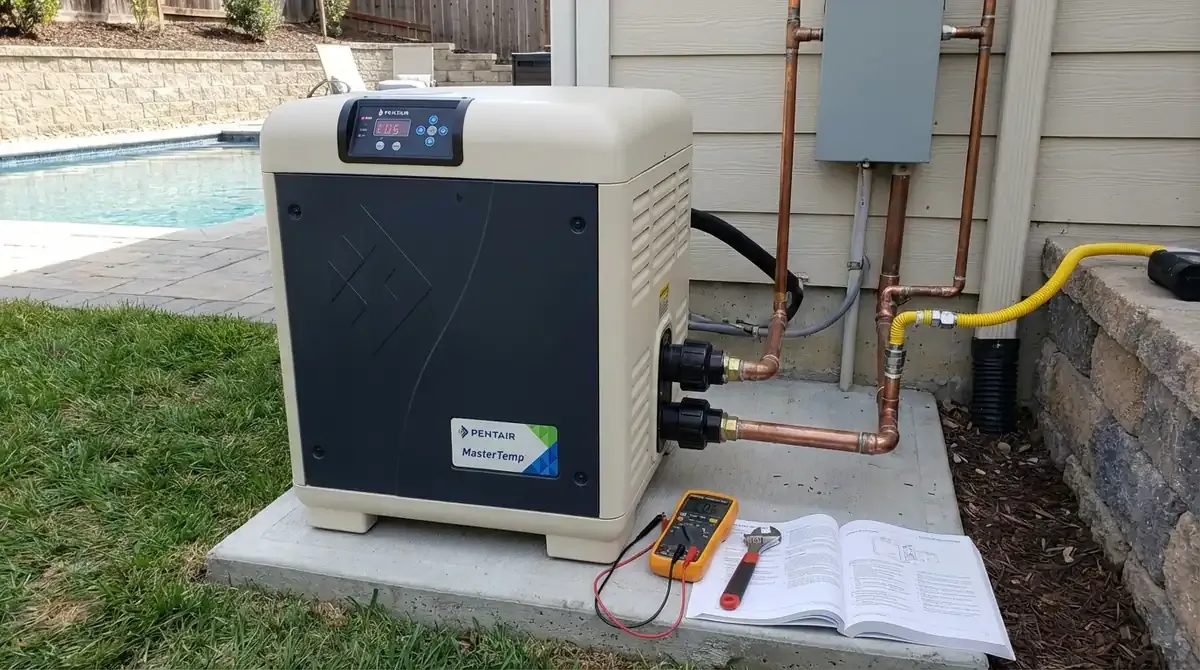
For pool pump and heater equipment pairing, see our guide on pool pump and heater equipment. For context on the broader heating decision, see the pool heater troubleshooting guide.
Is a pool heat pump right for you?
This guide is for you if:
- You’re considering a heat pump to heat your pool instead of gas or solar
- You want to understand the real operating costs over a season
- You’re replacing an aging gas heater and want to compare options
This guide is NOT for you if:
- Your existing heat pump isn’t working, see pool heater troubleshooting
- You’re looking for the cheapest upfront option (gas is usually cheaper to buy), see the full pool heater cost guide
- You live in a climate below 50°F for most of the swimming season (heat pumps lose efficiency in cold air)
Quick answer: is a pool heat pump worth it?
Heat pumps are energy-efficient with a COP of 5-7, meaning they produce $5-$7 of heat per $1 of electricity. They work best in climates with air temperatures consistently above 50°F. The installed cost runs $2,500-$5,000, versus $1,500-$3,500 for a gas heater, but annual operating costs are typically 60-70% lower for heat pumps in warm climates. Lifespan is 5-10 years, slightly shorter than gas at 7-10 years. For pools used 5+ months per year in warm climates, a heat pump will almost always pay back its premium cost within 3-5 seasons.
How a pool heat pump works
A pool heat pump doesn’t generate heat by burning fuel. It moves heat from the surrounding air to the pool water, using a refrigerant cycle similar to a reverse air conditioner.
The process:
- A fan draws outside air across the evaporator coil
- The refrigerant inside the coil absorbs heat from the air and vaporizes
- The compressor pressurizes the refrigerant, raising its temperature further
- The hot refrigerant passes through the condenser, transferring heat to the pool water circulating through the unit
- The refrigerant cools, returns to liquid state, and the cycle repeats
The U.S. Department of Energy heat pump heater guide{:target=“_blank”} notes that heat pumps function most efficiently when outdoor temps are above 45-50°F. Below that threshold, the temperature differential between the refrigerant and the outside air shrinks, reducing heat transfer efficiency and driving COP toward 2.0-3.0. In cold air, a heat pump still works but costs significantly more per BTU than in warm air.
COP explained in plain language: A heat pump with COP 6 uses 1 kWh of electricity to move 6 kWh of heat from the air to the pool. An electric resistance heater moves 1 kWh of heat per 1 kWh of electricity. Pool heat pumps are inherently more efficient because they move heat rather than generate it.
For pools in climates where swim season includes temperatures below 50°F, a gas heater or dual-system setup (heat pump for warm months, gas for cool shoulder months) makes more sense.
Pool heat pump cost breakdown
| Cost Component | Typical Range |
|---|---|
| Heat pump unit (85,000-140,000 BTU) | $1,500-$4,000 |
| Installation labor | $500-$1,000 |
| Electrical circuit upgrade (if needed) | $300-$1,500 |
| Total installed | $2,500-$5,000+ |
| Annual operating cost (warm climate) | $500-$1,500/season |
5-year total cost comparison (warm climate, 15,000-gallon pool):
- Gas heater: $2,000 purchase + $5,000-$6,000 gas (5 seasons) = $7,000-$8,000
- Heat pump: $3,500 purchase + $2,500-$3,500 electricity (5 seasons) = $6,000-$7,000
- Heat pump payback period: 2-4 seasons in warm climates
Lifespan affects the math: gas heaters last 7-10 years, heat pumps 5-10 years. In a best-case scenario, both last 10 years. In a worst case, a heat pump may need replacement at year 5-6.
For ENERGY STAR pool equipment certification{:target=“_blank”}, look for units with COP ratings verified by the AHRI (Air-Conditioning, Heating, and Refrigeration Institute).
Sizing a pool heat pump: BTU calculator guide
Most heat pump buyers get this wrong by undersizing. With heat pumps, bigger is better than smaller because undersizing means the unit runs continuously at maximum output and still can’t keep up.
Rule of thumb: 50,000 BTU per 10,000 gallons in a warm climate. Add 10-15% for cooler climates or pools with significant shade.
| Pool Size | Recommended BTU |
|---|---|
| Up to 15,000 gal | 85,000-100,000 BTU |
| 15,000-25,000 gal | 100,000-140,000 BTU |
| 25,000+ gal | 140,000+ BTU |
Factors that push you toward the higher end:
- Significant shading (north-facing or tree-covered pools heat more slowly)
- High wind exposure (wind strips heat from the water surface)
- Desired temperature rise above 80-82°F (diminishing returns as pool temp rises)
- Pool used early spring or late fall when air temps are marginal
For variable-speed pump pairing, see our guide on variable-speed pump pairing. Variable-speed pumps can cut total equipment electricity costs by 30-50% and also provide the flow rates heat pumps need at lower energy cost.
Gas heater vs heat pump: which is better?
| Factor | Gas Heater | Heat Pump |
|---|---|---|
| Upfront cost | $1,500-$3,500 installed | $2,500-$5,000 installed |
| Monthly operating cost | Higher (gas) | Lower (electricity) |
| Heating speed | Fast (heats in hours) | Slow (heats over 24+ hours) |
| Climate dependency | Works in any weather | Underperforms below 50°F |
| Lifespan | 7-10 years | 5-10 years |
| Environmental impact | Combustion emissions | No combustion |
| Best for | Infrequent use, fast heat-up | Frequent use, warm climates |
Our verdict: Gas wins for pools used occasionally or in climates with cold swim-season nights. Heat pumps win for pools used 5+ months per year in warm climates where the lower monthly cost pays back the higher purchase price within a few seasons.
For a solar option comparison, see our solar pool heater comparison.
Best pool heat pump models (2026)
These models represent what we consider the best options across price tiers in 2026. Verify current pricing before purchasing, as heat pump costs fluctuate with refrigerant and component costs.
Entry tier ($1,500-$2,500 unit):
- AquaCal TropiCal TC100: 95,000 BTU, COP 5.0, suitable for pools up to 15,000 gallons. Quieter than many competitors at 68 dB. Good for warm-climate pools in the Southeast.
Mid tier ($2,500-$3,500 unit):
- Hayward HeatPro HP50HA: 50,000 BTU, COP 5.8, designed for smaller pools up to 12,000 gallons. Titanium heat exchanger resists corrosion better than copper. See Hayward heat pump specifications{:target=“_blank”} for full spec sheet.
- Pentair UltraTemp 140: 140,000 BTU, COP 5.0, handles pools up to 25,000 gallons. MagicTouch 2 controller integrates with Pentair automation systems.
Premium tier ($3,500+ unit):
- AquaCal TropiCal TC200: 100,000 BTU, COP 6.5, one of the higher COP ratings in the residential segment. Better performance in marginal temperatures (works down to 45°F with reasonable efficiency).
- Raypak 10-HP: 140,000 BTU, digitally controlled, designed for reliability in demanding climates. Raypak’s heat pumps carry the same warranty reputation as their gas products.
Key specs to compare when shopping:
- COP at 80°F air / 80°F water (standard rating condition)
- Sound level in decibels (most range 60-72 dB)
- Minimum operating temperature (some shut off below 45°F, others below 35°F)
- Warranty (unit + compressor, compressor warranty is most important)
Installation: what to expect
Pool heat pumps require professional installation. The reasons are not just convention: heat pump installation involves 240V electrical work and sometimes refrigerant handling (for certain service scenarios), both of which require licensed contractors.
What the installer does:
- Sizes the unit for your pool volume and climate
- Positions the unit (minimum 24 inches of clearance on all sides; 18-24 inches above grade for drainage)
- Runs plumbing connections to the existing equipment pad
- Installs or verifies the dedicated 240V electrical circuit (typically 50-60A)
- Programs the controller
Installation time: Typically one day for an experienced pool equipment installer.
Electrical note: Most heat pumps require a dedicated 240V, 50-60A circuit. If your equipment panel doesn’t have spare capacity, you may need a panel upgrade, add $500-$1,500 to the project cost. A licensed electrician must do this work; this is not a DIY task.
Placement tip: Place the unit away from bedroom windows. Heat pumps are not silent, most operate at 60-72 dB, similar to a window air conditioner. Place where exhaust air can flow freely and won’t discharge directly toward your neighbor’s property.
FAQ
How efficient is a pool heat pump?
A pool heat pump with a COP of 6.0 produces $6 of heat energy for every $1 of electricity consumed. Quality residential heat pumps achieve COP ratings of 5-7 under standard test conditions (80°F air, 80°F water). Real-world efficiency varies with air temperature: COP drops as air temperature decreases. At 50°F air, expect COP around 3.5-4.0. At 80°F air, COP may reach 6-7. ENERGY STAR certified units are third-party tested and labeled with verified COP ratings.
How long does a pool heat pump take to heat a pool?
A pool heat pump heats water more slowly than a gas heater. Expect a 1-2°F per hour rise at typical operating conditions (80°F air, standard flow). A 15,000-gallon pool that needs to rise 10°F will take 10-20 hours of continuous operation. Gas heaters can heat the same pool in 6-12 hours. This is why heat pumps are better suited for maintaining temperature (run overnight, pool warm by morning) than rapid on-demand heating.
Can a pool heat pump work in cold weather?
Pool heat pumps work best when outdoor air temperatures stay consistently above 50°F. Below that threshold, efficiency drops sharply and heating times increase. Most residential units shut off automatically below 40-45°F air temperature to protect the compressor. In climates where the swim season regularly includes temperatures below 50°F, a gas heater or dual-system approach (heat pump for warm months, gas for shoulder months) is more practical. Pool heat pumps are not suitable as the sole heating source in climates where the swimming season includes temperatures below 50°F.
How long do pool heat pumps last?
Pool heat pumps last 5-10 years on average, compared to 7-10 years for gas heaters. The compressor is the most expensive component and is typically covered by a separate warranty period (5-7 years on premium models). Titanium heat exchangers outlast copper in saltwater pool applications. Annual service (cleaning the evaporator coil, checking refrigerant levels, clearing drain lines) extends lifespan significantly.
What size heat pump do I need for my pool?
A solar pool heater requires collector area equal to 50-100% of the pool’s surface area. For a heat pump, use this sizing rule: 50,000 BTU per 10,000 gallons of pool volume as a minimum in warm climates, more in cooler climates. A 15,000-gallon pool needs 75,000-100,000 BTU of heat pump output. A 25,000-gallon pool needs 125,000-140,000 BTU. Always size up rather than down, an oversized heat pump runs in shorter cycles and maintains temperature more efficiently than an undersized unit running continuously.