How to Open a Pool for Summer (Step-by-Step)
Open your pool when water temperature consistently stays above 65°F, typically late March through May depending on your region. Day 1 takes 1-3 hours. Budget $85-$140 in chemicals for a DIY opening. If the pool is green after winter, recovery takes 3-7 days with a heavier shock dose. We walk through the full sequence below, including a separate protocol for green pool recovery.
For a quick reference version, see our spring pool opening checklist. For the full pool maintenance guide for beginners, start there if this is your first season managing a pool.
Is this guide for you?
This guide IS for you if:
- You are opening a residential pool for spring, any pool type
- You want the full step-by-step procedure with chemistry sequence
- Your pool is green after winter and you need a recovery plan
This guide is NOT for you if:
- You only want a printable checklist (see our spring pool opening checklist)
- You want to know what service companies charge (see our pool opening service cost page)
Video guide
Video: “How To OPEN An INGROUND POOL” by Swim University
When to open your pool
The temperature trigger is 65°F, consistently, over several days. Below this threshold, algae growth slows dramatically, so there’s no rush to beat an algae bloom. Above 65°F, algae can establish on pool walls quickly. We’ve seen pools develop a light green film on walls within a week of warm weather under a dirty cover.
“Open your pool when water temperature consistently stays above 65°F. Below this threshold, algae growth slows, so opening earlier wastes chemicals without protecting against algae.” Checking a 10-day weather forecast before removing the cover is the practical way to apply this rule.
Regional timing guidelines:
- Southeast/Southwest (FL, TX, AZ): February-March
- Mid-Atlantic and Midwest: April-May
- Northeast and North-Central: May
Opening too early means you pay for chemicals before swim season. Opening too late (hot water in May-June) means algae may establish on pool walls before you add the first dose of sanitizer.
What you’ll need
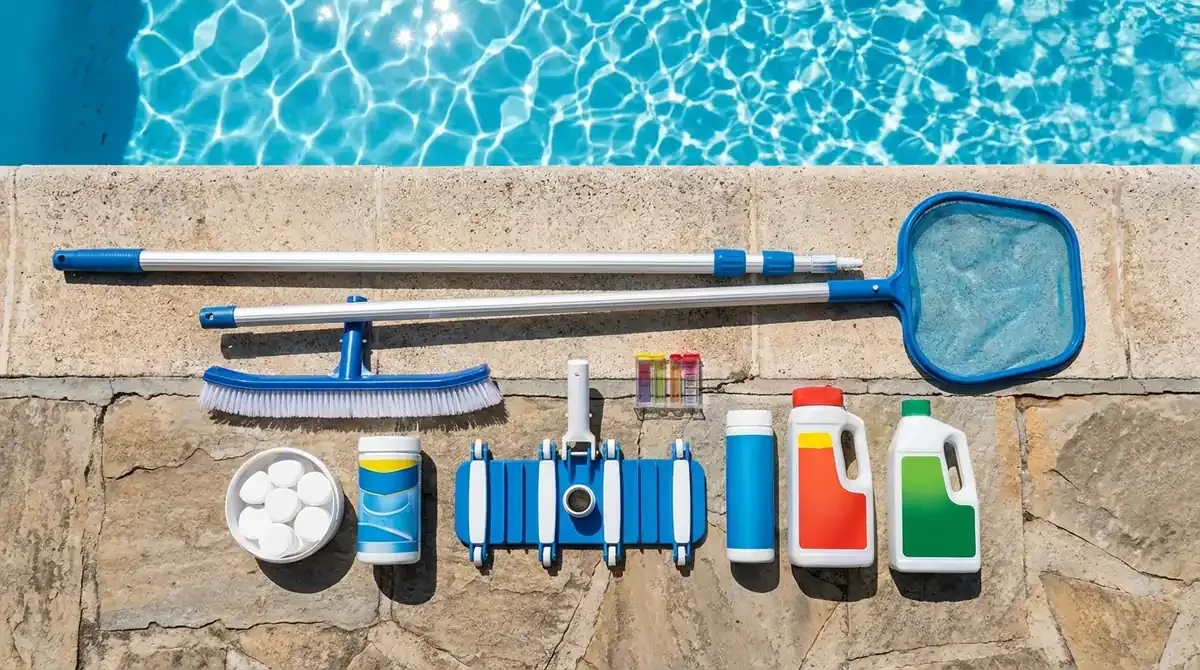
Gather supplies before Day 1. Most of these are available at pool supply stores or home improvement centers.
Chemicals:
| Item | Amount | Notes |
|---|---|---|
| Shock (Cal-Hypo 65%) | 5-10 lbs | 2 lbs/10k gal normal; 3-4 lbs/10k gal for green pool |
| Algaecide (polyquat 60) | 1 quart | Add after shock dissipates |
| pH up (soda ash) | 2 lbs | Test first; have both up and down on hand |
| pH down (muriatic acid) | 1 quart | If pH is high |
| TA increaser (baking soda) | 5 lbs | If TA below 80 ppm |
| CYA stabilizer | 2-3 lbs | If CYA below 30 ppm |
| Test kit or strips | 1 | Liquid test kit more accurate |
DIY total cost: $85-$140 per Pinch A Penny’s pool opening guide{:target=“_blank”} for standard chemical needs.
Equipment:
- Garden hose (to top up water level)
- Pump primer bucket
- Pool brush (wall/floor)
- Vacuum and hose
- Skimmer net
Day 1: equipment setup (before chemistry)
Do not add any chemicals until the equipment is running. Chemicals added to stagnant water distribute unevenly and can damage surfaces.
- Remove the winter cover. Brush or blow off debris before pulling the cover, to avoid dumping it into the pool. Fold carefully.
- Clean and store the cover. Dry it completely before folding for storage to prevent mildew damage.
- Remove all winterizing plugs. Check every return jet and skimmer line for plugs. Missed plugs cause flow problems and can damage equipment when the pump starts.
- Reinstall skimmer basket, pump basket, pump lid with gasket, and pressure gauge. Inspect the lid o-ring before sealing.
- Reinstall all return fittings, ladders, and any removed hardware.
- Top up the water level to mid-skimmer opening. The pump will not prime properly if the water is too low.
- Prime and start the pump. Fill the pump basket with water before starting. If priming is slow, close all but one return jet to build suction.
- Check for leaks at all unions, filter housing, and fittings. Address drips before continuing.
- Reconnect the filter. For sand or DE filters, backwash before running. For cartridge filters, inspect and reinstall the cartridges. See our guide to filter inspection and cleaning on opening day for cartridge-specific steps.
- Verify flow from all return jets. Low or no flow from a specific return usually means a plug was missed or a line blockage.
Day 1: initial chemical treatment
Chemistry sequence matters. Adding chemicals in the wrong order either wastes product or creates dangerous reactions.
- Test the water first. Before adding anything, test for pH, TA, and free chlorine. Opening water is often more balanced than expected from winter resting.
- Adjust Total Alkalinity first. If TA is below 80 ppm, add baking soda (sodium bicarbonate): 1.5 lbs per 10,000 gallons raises TA by roughly 10 ppm. If above 120 ppm, add muriatic acid gradually with the pump running.
- Adjust pH to 7.4-7.6. After TA is in range. Add soda ash to raise; muriatic acid to lower. Wait 1 hour between additions and retest.
- Shock the pool. Add 2 lbs Cal-Hypo 65% per 10,000 gallons at dusk or night. Shocking at night prevents UV from degrading chlorine before it has time to work. For a green pool, use 3-4 lbs/10,000 gallons. See our pool shock treatment guide for pre-dissolving Cal-Hypo safely.
- Run the pump continuously for at least 24 hours after shocking. Do not stop circulation.
- Wait for FC to drop below 5 ppm before adding algaecide. This typically takes 24-48 hours.
- Add algaecide. Pour polyquat 60 around the pool perimeter on Day 2 or whenever FC tests below 5 ppm.
Week 1: getting the water balanced
The first week requires more attention than regular maintenance. Chemistry fluctuates more as the water adjusts to a new season.
- Test daily for free chlorine and pH at minimum. Run a full panel (TA, CYA, calcium hardness) by Day 3.
- Add CYA stabilizer if CYA is below 30 ppm. Wait until after the initial shock has dissipated to add CYA, because CYA slows chlorine activity and you need high FC right after opening. Add 1 lb of stabilizer per 4,000 gallons to raise CYA by 10 ppm.
- Brush walls, steps, and floor daily. Brushing loosens algae from surfaces so the filter and sanitizer can remove it.
- Vacuum when water clears enough to see the bottom, usually Day 2-4 for clear pools.
- Clean the filter when pressure rises 8-10 PSI above the clean starting pressure. Opening loads the filter heavily.
- Goal by end of Week 1: clear water, stable chemistry, and a filter running at normal pressure.
For complete parameter targets after opening, see our guide to balancing pool chemistry after opening.
According to CDC pool water testing guidelines{:target=“_blank”}, free chlorine and pH should be tested at least 2-3 times per week during regular maintenance, and more frequently during the first week after a chemical treatment.
Green pool recovery protocol
A green pool means algae established during winter or because the cover failed. This is common and fixable, but do not treat it the same way as a clear pool opening. Standard shock doses will not be enough.
- Remove large debris first. Use a leaf net to pull out leaves, debris, and any solid material before starting the pump. Running the pump with heavy debris clogs filters immediately.
- Start the pump and run continuously. Do not stop circulation.
- Shock heavily: 3-4 lbs Cal-Hypo 65% per 10,000 gallons at dusk.
- Run the filter 24/7. Backwash or clean the filter when pressure rises, then continue filtering.
- Brush daily. Manually breaking up algae adhering to walls, steps, and floor makes a significant difference in recovery speed.
- Do NOT add algaecide until FC tests below 5 ppm. This is not optional: chlorine destroys algaecide on contact and the money is wasted.
- Expect 3-7 days to clear for light to moderate algae. Severe black algae or heavy green algae may take up to 14 days.
When the water shifts from green to cloudy blue, that is a success indicator. Dead algae is being filtered out. Keep the pump running and resist the urge to add more product.
Pool opening cost
A DIY pool opening runs $85-$140 in chemicals for a standard clear pool opening, based on pricing from Pinch A Penny. If the pool is green, add $30-$60 for the additional shock doses required.
| Item | DIY Cost |
|---|---|
| Shock (Cal-Hypo 65%) | $35-$55 |
| Algaecide (polyquat 60) | $15-$25 |
| pH up/down | $10-$20 |
| TA increaser | $10-$15 |
| CYA stabilizer | $15-$25 |
| Total DIY | $85-$140 |
| Green pool surcharge | +$30-$60 |
| Professional opening service | $100-$250 |
Per EPA pool water efficiency guidelines{:target=“_blank”}, topping up to mid-skimmer level before starting the pump is also a water conservation consideration, since overfilling wastes water through backwash and overflow.
For a complete breakdown including labor rates by region, see our pool opening service cost guide.
After opening season, the reverse process matters just as much. See our guide on how to close your pool for winter when the time comes.
FAQ
When should I open my pool for summer?
Open when water temperature consistently stays above 65°F for several consecutive days. Below 65°F, algae growth is slow enough that the pool is safe under a cover. Above 65°F, algae can establish quickly on pool walls, especially with debris on the cover and warming sun. Use a 10-day weather forecast to pick an opening window with stable temperatures.
How long does it take to open a pool?
Day 1 equipment setup and initial chemistry takes 1-3 hours for most pools. The chemistry then takes 1 week to fully stabilize. You can swim once free chlorine drops to 4 ppm or below and pH is in the 7.4-7.6 range, which is typically 24-48 hours after the initial shock.
What if my pool is green after winter?
Use a higher shock dose: 3-4 lbs Cal-Hypo 65% per 10,000 gallons instead of the standard 2 lbs. Run the filter 24/7, brush walls daily, and do not add algaecide until FC tests below 5 ppm (usually 48+ hours after heavy shocking). Expect 3-7 days to clear for light to moderate algae.
Can I add all opening chemicals at once?
No. Follow the sequence: Total Alkalinity first, then pH, then shock. Add algaecide last and only after FC drops below 5 ppm. Adding chemicals out of order wastes product, causes reactions, and can damage pool surfaces. Wait at least 1 hour and preferably 4-6 hours between major chemical additions.
Do I need to shock a pool when opening?
Yes, always. Even if the water looks clear after winter, organic contaminants and bacteria have been accumulating under the cover. Shock on opening day regardless of water clarity. A clear pool in spring has lower organic load but still needs an oxidizing treatment before the swim season begins.