How to Clean a Pool Filter Cartridge: Rinse, Soak, and Acid Wash
When your pool filter pressure gauge reads 8-10 PSI above your baseline, it is time to clean the cartridge. That single number is your best trigger, not a fixed schedule. If you want to make this part of your pool filter cleaning guide, this step-by-step walkthrough covers the three-stage process that most homeowners never complete: rinse, degreaser soak, and acid wash. Most owners do only the rinse. Skipping the soak is exactly why their cartridges wear out in 1-3 years instead of 5-7.
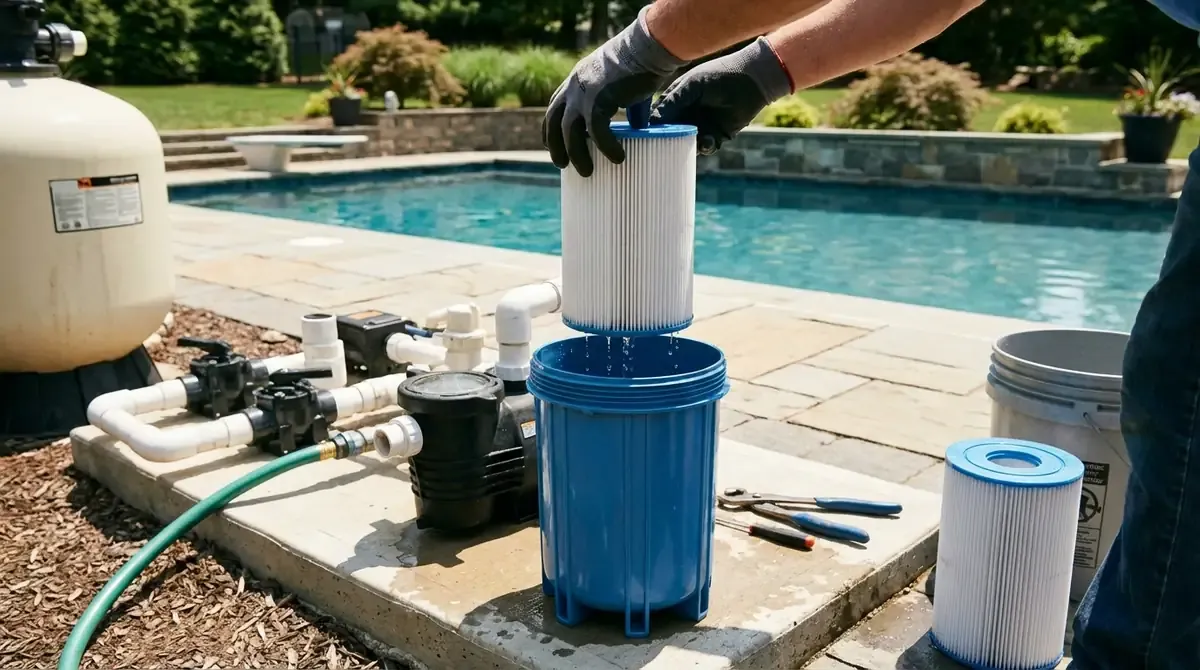
Video guide
Video: “How to Safely Clean a Pentair Cartridge Filter” by Pentair
When does a cartridge filter need cleaning?
The pressure gauge on top of your filter is the definitive trigger. TroubleFreePool’s expert community recommends cleaning at 8 PSI above your clean baseline; Pentair’s official guidance says 10 PSI. We use the more conservative 8 PSI threshold because catching buildup early prevents pressure spikes that can damage the filter housing.
How to establish your baseline: Right after each cleaning, write the PSI reading on a piece of tape attached to the filter. That number is your next cleaning trigger. If baseline is 10 PSI, clean when gauge reads 18-20 PSI.
Secondary signals worth noting:
- Reduced return flow from jets despite pump running normally
- Pool stays cloudy even with balanced chemistry
- Heavy bather weeks (sunscreen, body oils load up the pleats faster)
For a full maintenance schedule, see our pool filter maintenance schedule and guidance on how often to clean your filter.
What you will need
Gather everything before you start. Stopping mid-clean to find tools is the most common reason people skip steps.
Required:
- Garden hose with spray nozzle (NOT a pressure washer)
- Large plastic tub or trash can (minimum 5-gallon capacity)
- Automatic dishwasher detergent (1 cup per 5 gallons of water)
- Petroleum-free silicone lubricant for the O-ring
For Pentair filters specifically:
- Ratchet wrench with 7/8” socket
- Dead-blow hammer (for stubborn housing clamps)
For acid wash step (scale only):
- Muriatic acid
- Rubber gloves and eye protection
- Second large bucket for mixing
The dishwasher detergent distinction matters more than it sounds. Liquid dish soap creates foam that gets into the pool and lingers for days. Automatic dishwasher detergent is the correct product: it breaks down oils without the sudsing agents. Commercial alternatives like Natural Chemistry Filter Perfect or BioGuard Filter Brite work well too.
Step 1: shut down and disassemble safely
- Turn off the pool pump at the control panel.
- Switch off power at the circuit breaker. Pentair specifically recommends this step to prevent automation systems from restarting the pump while the housing is open.
- Open the air relief valve on top of the filter and allow 1-2 minutes for pressure to fully release.
- Unscrew or un-clamp the filter housing top. Pentair units typically use a ratchet wrench with a 7/8” socket.
- Lift the cartridge straight out of the housing.
Before setting the cartridge down, note whether the O-ring looks intact. Older O-rings can be brittle and prone to cracking during handling. If you see cracks or dry-rot, order a replacement before reassembly.
For the full manufacturer-recommended procedure, see the Pentair cartridge filter cleaning guide{:target=“_blank”}.
Step 2: rinse the cartridge (every cleaning)
To clean a pool filter cartridge correctly with a garden hose, spray it at a 45-degree angle from top to bottom, working between every pleat. Never spray horizontally or straight down. The angle allows debris to fall away from the pleats rather than driving it deeper into the fabric.
- Place the cartridge on a clean driveway or grass (avoid gravel, which embeds into wet pleats).
- Hold at a 45-degree angle with the top end slightly elevated.
- Spray from top to bottom, working the nozzle between each individual pleat.
- Rotate the cartridge 90 degrees and repeat on all four sides.
A thorough hose rinse removes dirt, leaves, and debris. What it does not remove: sunscreen, body oils, and lotions. Those require the soak step. Many owners rinse, see the cartridge looking clean, reinstall it, and wonder why pressure spikes again within two weeks. The oils are still there, invisible, clogging the polyester fibers.
Step 3: degreaser soak (every 1-3 months or when visually dirty)
Cartridge filters require a degreaser soak every 1-3 months, not just rinsing. Soak the cartridge overnight in 1 cup of automatic dishwasher detergent per 5 gallons of water. This step removes sunscreen and body oils that hose rinsing cannot reach.
Why this step is the most important: sunscreen and body oils coat the polyester pleat material and cannot be removed mechanically. They accumulate over time, reduce filtration efficiency, and accelerate fabric degradation. The degreaser soak dissolves them chemically. Skipping this step is the primary reason cartridges wear out prematurely.
Soak procedure:
- Fill a large tub or trash can with cool water.
- Add 1 cup of automatic dishwasher detergent per 5 gallons.
- Submerge the cartridge completely. Weight it down if needed.
- Soak for 8+ hours minimum. Overnight is standard. Shorter soaks are ineffective.
- Remove and rinse thoroughly with fresh water.
For the complete Instructables 16-step process with photos, see the full 16-step cartridge cleaning guide{:target=“_blank”}.
Commercial alternatives to dishwasher detergent:
- Natural Chemistry Filter Perfect (premixed, no measuring)
- BioGuard Filter Brite (concentrated, same degrease action)
TroubleFreePool’s community notes that TSP (trisodium phosphate) is an effective option but is increasingly restricted or banned across US states.
Step 4: acid wash (only for mineral scale, only after degreasing)
Most cartridges do not need an acid wash. Only use muriatic acid if white or gray mineral deposits remain on the pleats after the degreaser soak. If the pleats look clean after soaking, skip this step.
The degrease-before-acid rule explained: Muriatic acid applied to oil-contaminated filter material reacts with the oils and permanently bonds them to the polyester fibers. The damage is irreversible. No amount of additional cleaning will recover the filter. Always degrease first and verify the pleats are oil-free before considering acid.
Acid wash procedure:
- Put on rubber gloves and eye protection.
- Mix 20 parts water to 1 part muriatic acid in a large bucket. Always add acid to water, never water to acid.
- Submerge the cartridge in the acid solution.
- Soak until bubbling stops (approximately 20 minutes for typical scale).
- Remove the cartridge and drain the acid solution properly.
- Rinse immediately and thoroughly with fresh water. Multiple rinse cycles.
- The cartridge should have no chemical odor before reinstalling.
Note: Instructables recommends a 1:10 ratio (more dilute approach), while TFP’s standard is 20:1. We follow TFP’s 20:1 ratio as the gentler, more protective approach for the filter material.
Step 5: reinstall and record baseline
Proper reassembly prevents leaks and establishes your next cleaning trigger.
- Inspect the O-ring. Look for cracks, deformation, or dry-rot.
- Apply petroleum-free silicone grease to the O-ring. Never use petroleum-based lubricant, it swells and deteriorates rubber O-rings within weeks.
- Seat the O-ring in its groove. Verify it is not twisted.
- Place the cartridge back in the housing.
- Close the housing and tighten the clamp or screws.
- Restore power to the pump at the circuit breaker.
- Open the air relief valve. Let the pump run until a steady stream of water exits the valve, then close it.
- Note the pressure gauge reading. Write this number on the tape attached to your filter. This is your new baseline.
Pentair’s guidance: expect a steady water stream from the air relief valve within 30 seconds. If the pressure reads differently than your previous clean baseline, check that the cartridge is properly seated.
Pro tips for longer cartridge life
A pool filter cartridge properly maintained with regular degreaser soaks, no pressure washing, and complete drying between uses can last 5-7 years, compared to the 1-3 year replacement cycles typical for improperly maintained filters.
The two-cartridge system: Keep one cartridge in the filter and one drying completely in storage. When it is time to clean, swap in the dry cartridge, then soak and dry the removed one. TroubleFreePool members consistently report this practice as the single most impactful longevity strategy. Moisture accelerates polyester degradation.
When to replace rather than clean:
- Pleats show physical tears or collapse
- Cartridge will not clean up after a full degreaser soak
- Pool stays persistently cloudy despite balanced chemistry and a clean cartridge
- Physical damage from pressure washer use
Replacement cost ranges from $30 for small above-ground units to $200 for large inground systems. Budget for replacement every 5-7 years with proper maintenance. Less if you pressure wash or skip the soak step.
For new pool owners, our pool maintenance for beginners guide covers the full maintenance picture. If pressure stays elevated even after a thorough clean, check our pool pump troubleshooting guide to rule out pump-side causes.
FAQ
How often should I clean my pool filter cartridge?
Clean a pool filter cartridge when the pressure gauge reads 8-10 PSI above your clean baseline, or at a minimum of once per month during heavy swim season. For a pool with regular use and several swimmers weekly, monthly cleaning is a reasonable baseline. If your pressure triggers early (within two weeks), it usually means the cartridge needs a degreaser soak rather than just a rinse.
Can I clean my cartridge with bleach?
We do not recommend bleach for routine cleaning. Bleach can break down the polyester fiber bonding in filter pleats with repeated use. The dishwasher detergent soak handles oil and organics more effectively without degrading the filter material. If you want to sanitize the filter, a rinse with a very dilute bleach solution (1 part bleach to 100 parts water) after degreasing is occasionally used, but it is not a standard recommendation.
Why does my pool stay cloudy after cleaning the filter?
Cloudy water after cleaning usually means one of three things: the filter was rinsed but not degreased (oils still clogging pleats), the chemistry is out of balance (check pH, alkalinity, and free chlorine), or the cartridge itself is worn out and needs replacement. If you cleaned with only a hose rinse, try a full overnight degreaser soak before replacing the cartridge.
How do I know when to replace (not clean) my cartridge?
Replace a cartridge when: pleats show physical tears or collapse, the cartridge fails to clean up after a proper overnight degreaser soak, or pool water stays persistently cloudy despite balanced chemistry and a properly cleaned filter. If the cartridge has been in service for 5-7 years with proper maintenance, or 1-3 years without, replacement is likely overdue.
Is it OK to reinstall a wet cartridge?
You can reinstall a wet cartridge in an emergency, but it accelerates wear. Wet polyester degrades faster than dry polyester under the mechanical stress of filtration. The TroubleFreePool community’s consistent advice: if you have a second cartridge available, always swap in the dry one and let the cleaned cartridge dry fully before storage. If you have only one cartridge, reinstalling wet is acceptable, but plan to use the two-cartridge rotation system going forward.