Hot Tub Maintenance Cost: Monthly and Annual Breakdown
Hot tub maintenance costs $75-200 per month for DIY owners, broken into three main categories: chemicals ($30-60), electricity ($30-100), and filter and drain supplies ($15-35). Plan on $900-2,300 per year when you account for filter replacements and quarterly drain events. The range is real, climate, usage frequency, and cover quality are the variables that move the needle.
For a complete view of what’s included in that maintenance budget, see our complete hot tub maintenance guide.
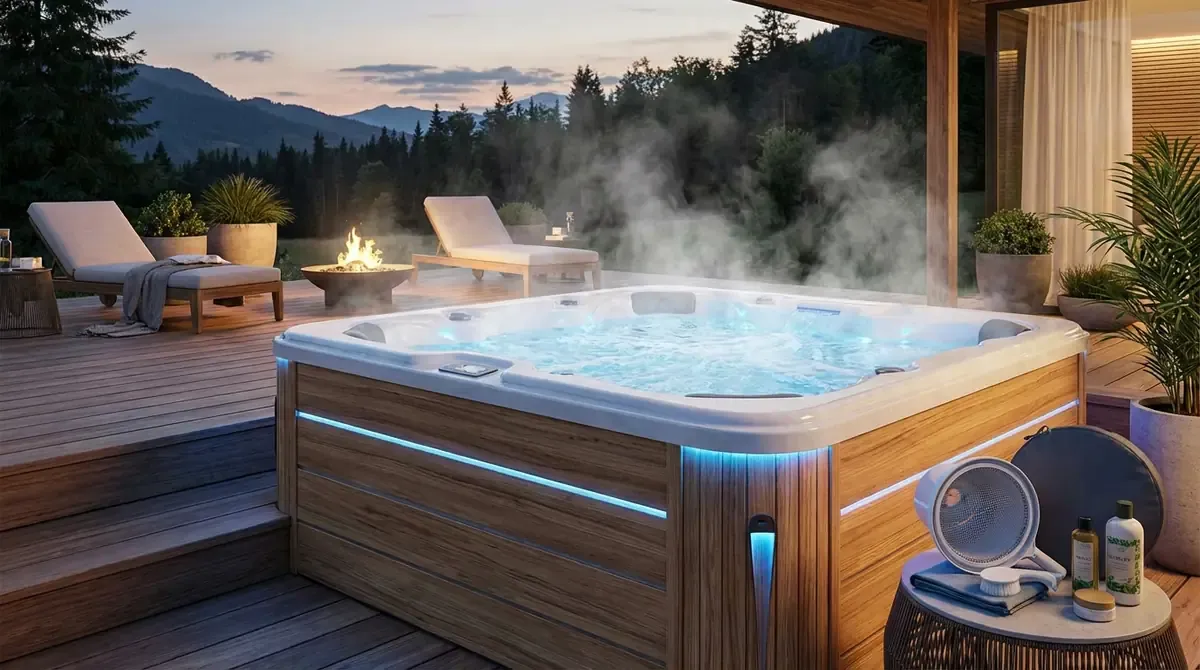
Cost summary
| Category | Monthly | Annual |
|---|---|---|
| Chemicals (sanitizer, pH, shock) | $30-60 | $360-720 |
| Electricity (heating and pump) | $30-100 | $360-1,200 |
| Filter maintenance (cleaning and replacement) | $5-15 | $60-180 |
| Drain and refill supplies | $10-20/drain | $40-80 (3-4x/year) |
| Annual professional service inspection | , | $100-200 (optional) |
| Total (DIY) | $75-195 | $900-2,300 |
Use $100/month as your planning number. It’s in the middle of the real range and accounts for the occasional higher-cost month (filter replacement, drain event with flush products).
Chemical costs ($30-60/month)
Chemicals are the most variable line item because usage drives them more than any other factor. A spa used daily by multiple people burns through sanitizer and shock much faster than a spa used twice a week by one person.
Sanitizer: Chlorine dichlor granules cost roughly $10-15 per pound; bromine runs $15-25 per pound. Monthly use is typically 0.5-1 pound for an average residential spa. SwimUniversity recommends maintaining chlorine at 3-5 ppm or bromine at 4-6 ppm, higher usage frequency means more frequent dosing to stay in range.
Shock: Non-chlorine shock (MPS, potassium monopersulfate) costs $10-20 per pound and should be used after every session or at minimum weekly. MPS allows re-entry in 15 minutes vs. waiting for chlorine to drop below 5 ppm, most spa owners prefer it for convenience.
pH and alkalinity adjusters: Budget $10-20/month for pH up (sodium carbonate) and pH down (sodium bisulfate) to maintain pH at 7.4-7.6 and total alkalinity at 80-120 ppm. These costs vary based on your source water’s natural tendency to drift.
Calcium hardness increaser: Occasional addition only when calcium drops below 150 ppm. Budget $10-15 for the purchase; use is infrequent for most owners.
You can learn more about chemical balancing in our guide to the hot tub maintenance schedule.
Electricity costs ($30-100/month)
Electricity is often the largest ongoing cost but gets the least attention in maintenance guides. The DOE hot tub energy efficiency guidance{:target=“_blank”} estimates well-insulated spas cost $20-50/month to operate in mild climates; poorly insulated spas in cold climates run $75-150/month.
What drives your bill:
- Climate: Running a 104°F spa when it’s 10°F outside costs 3-4x more than the same spa at 70°F ambient
- Cover quality: A worn, waterlogged cover can double your heating cost. The foam core absorbs water over time, losing insulation value. A saturated cover feels noticeably heavier than a new one
- Set temperature: Each degree above 100°F adds measurable cost. At 104°F vs. 100°F, you’re heating 4 additional degrees continuously
- Pump run time: Older single-speed pumps run at full power all the time. Newer variable-speed pumps reduce circulation cost substantially
Filter costs ($60-180/year)
Filters are a low monthly cost that shows up as larger purchases 1-2 times per year.
Standard cartridge filter: $30-80 to replace; expected lifespan is 1-2 years with regular cleaning. If you’re cleaning monthly with a filter cleaner soak (recommended), filters typically last toward the longer end of that range.
EcoPur Charge filter (Master Spas): Per manufacturer specifications, EcoPur media filters must be replaced every 6 months at $50-100 per filter. They cannot be cleaned with filter cleaner, it damages the media. This is the one case where the $100/6-month replacement schedule is not optional.
Filter cleaning supplies: Commercial filter cleaner runs $10-20 for a bottle that covers 2-3 months of monthly soaks. Monthly chemical cleaning extends cartridge life and is worth the cost.
The rotation strategy: Running two cartridge filters and alternating them extends individual filter life significantly. You always have a clean, dry filter ready. The upfront cost of buying two filters pays back in reduced replacement frequency. See our guide on drain and refill costs for how the drain schedule interacts with filter timing.
For detailed filter maintenance steps, see the Master Spas maintenance schedule and costs{:target=“_blank”}.
Drain and refill costs ($40-80/year)
Each drain and refill event costs $25-45 in supplies and $2-5 in water.
Water cost: A typical 300-500 gallon residential spa costs $2-5 to refill depending on your water rate. Not a significant cost.
System flush product: $10-20 per use (Ahh-Some, Natural Chemistry Spa Purge). Run with jets for 30 minutes before draining to clear biofilm from plumbing lines. Both SwimUniversity and Master Spas specify this step, we recommend not skipping it.
Pre-filter for garden hose: $15-25 per filter, optional but valuable for reducing mineral load in hard water areas. One filter typically covers 2-3 refills.
Sequestering agent: $10-15 per use on fresh fill. Keeps dissolved minerals in solution rather than letting them deposit on the shell and heater.
Drain frequency: SwimUniversity recommends every 3-4 months; Master Spas specifies every 6 months. We’ve found 3-4 months works better for spas with frequent use or multiple bathers. TDS (total dissolved solids) climbs faster in heavily used spas.
Total drain and refill cost per event: $25-45. At 3-4 events per year, that’s $75-180 annually.
Optional and occasional costs
Annual professional service inspection ($100-200): Covers pump inspection, heater check, seal evaluation, and electrical review. Worth doing if your spa is more than 5 years old or if you’re buying a used spa.
Spa cover replacement ($150-500 every 3-7 years): A worn cover that lets heat escape can cost $50-100/month extra in electricity. Cover replacement is often the highest-ROI maintenance investment, the energy savings typically pay back a new cover in 18-24 months.
Ozonator replacement ($50-150 every 2-5 years): If your spa has an ozone generator, the UV bulb or corona discharge cell degrades over time. A working ozonator reduces sanitizer demand, which cuts chemical costs.
Filter housing gaskets and O-rings: $5-20 as needed. Inspect O-rings when cleaning filters, a cracked O-ring causes leaks and pump air intrusion.
DIY vs. professional maintenance cost
Full DIY maintenance: $900-1,500/year for most owners. Requires 15-20 minutes per week for testing and chemical adjustment plus monthly filter maintenance. For a full breakdown of what chemicals you need and when, see our hot tub chemicals guide.
Partial professional service: Pool service companies that offer spa programs typically charge $75-150/month for chemical management, $900-1,800/year just for chemistry, not including parts. Total cost with professional management: $1,500-3,000/year.
When professional service makes sense: Frequent travel, complex automation systems, or post-warranty spa with recurring equipment issues. For a straightforward residential spa, DIY maintenance at 20 minutes per week is the clear cost-winner. See the HomeAdvisor hot tub service cost data{:target=“_blank”} for regional professional service rate benchmarks.
For beginners learning pool and spa care together, our pool maintenance for beginners guide covers the overlap between pool and spa chemistry fundamentals.
How to reduce hot tub maintenance costs
These seven habits reduce annual cost meaningfully without cutting corners on water quality:
- Buy chemicals in bulk. Ten-pound bags vs. 1-pound bags cut per-dose cost by 30-50%. The chemicals are identical; the packaging markup is not.
- Maintain a quality cover. A waterlogged foam core is your biggest hidden energy cost. Replace covers when they start feeling heavy from water absorption.
- Test before every use. Catching an imbalance early costs $2 in chemicals. Correcting a crashed pool after 2 weeks of drift costs $30-50 and sometimes a drain.
- Drain on schedule. Pushing past 4 months on water means fighting rising TDS with increasingly expensive chemical correction. A timely refill resets the baseline.
- Rotate two filters. Alternating clean and dry filters extends individual filter life and improves water clarity between service intervals.
- Lower temperature when away. Five to ten degrees lower when away for 3 or more days saves meaningful energy without the full cost of reheating from a cold fill.
- Use enzyme products. Enzyme treatments break down body oils and organics, which reduces the sanitizer demand and extends time between drain events.
For context on how hot tub costs compare to pool ownership, see our saltwater pool cost comparison, the cost structures are more similar than most owners expect.
FAQ
How much does it cost to run a hot tub per month?
Most DIY-maintained hot tubs cost $75-200/month to operate, including chemicals and electricity. Budget $100/month as a planning figure, it’s realistic for a mid-range spa with 2-3 uses per week in a moderate climate. Spas in cold climates or with heavy daily use will trend toward the $200 end.
Is hot tub maintenance expensive compared to a pool?
On a per-gallon basis, yes. Hot tubs are expensive to maintain relative to their water volume because the high temperature accelerates chemical consumption and evaporation. But in absolute terms, total annual hot tub maintenance cost ($900-2,300) is much lower than a full-size inground pool ($1,200-3,000+), simply because of the volume difference.
How do I know if I’m overspending on hot tub chemicals?
Compare your monthly chemical spend to your drain frequency. If you’re spending $100+ per month on chemicals without persistent water quality problems, and you’re draining on the 3-4 month schedule, you’re likely overdosing. Use a test kit or strip before adding chemicals, not a set-it-and-forget-it schedule.
Can I use pool chemicals instead of spa-specific products?
Some, with careful dosing. Use dichlor granules (not trichlor tablets, they’re too acidic for spa volumes and will tank your TA). Many pool-brand products work in spas, the chemistry is the same. Always dose based on your spa volume (typically 300-500 gallons), not pool doses. A pool shock dose in a 400-gallon spa will send chlorine to toxic levels.
What’s the biggest hidden cost of hot tub ownership?
Usually electricity and cover replacement. A worn cover that loses its insulation value can add $50-100/month in heating costs, costs that accumulate silently until you replace the cover and see your electric bill drop. Most owners don’t realize the cover is the problem until they see the before/after on their utility bill.