Green Pool Water: How to Clear It Fast (Step-by-Step)
One reason your pool is green: algae. One fix: chlorine shock, a large amount of it, applied at night. For a light-green 20,000-gallon pool, you’ll need 4 lbs of cal-hypo shock tonight. For dark green, 8 lbs. You’ll know it’s working when the water turns cloudy blue, that’s dead algae being filtered out. Here’s the exact process, broken down by pool color.
Video guide
Video: “Green Pool CURE: How to Clear Up POOL ALGAE Overnight” by Swim University
Not sure you’re dealing with algae? Our pool algae types and causes hub covers all pool water problems including black spots, mustard algae, and calcium deposits, use it first if you’re not certain what you’re looking at.
How Green Is Your Pool? (Before You Start)
The severity of your green water determines how much shock to use. Getting this right saves money and prevents under-dosing (which means the algae survives and you start over).
Assess your pool color:
- Light green or teal, you can still see the bottom a few feet down: algae is early-stage. Use a 2x dose.
- Medium green, water is murky, you can’t see the bottom clearly: use a 3x dose.
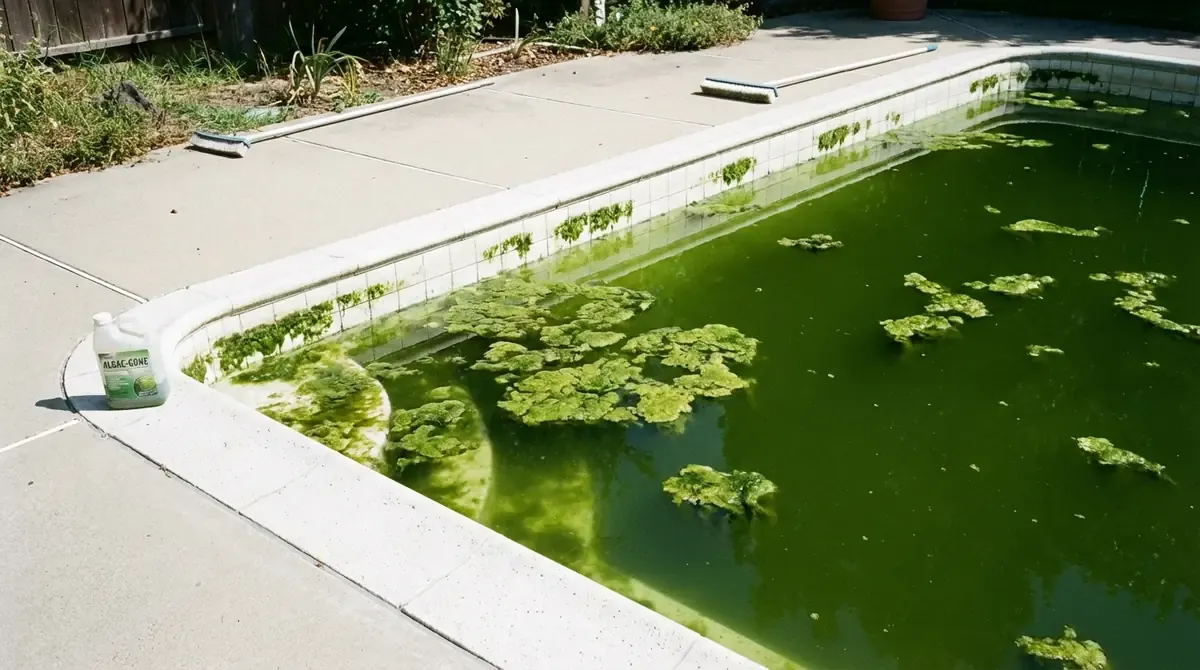
- Dark green, swamp water, you cannot see the pool floor at all: use a 4x (quadruple) dose.
What “1x” means: The standard shock dose is 1 lb of calcium hypochlorite per 10,000 gallons of pool water. For algae treatment, you multiply that baseline by 2, 3, or 4 depending on severity.
Example calculation:
| Pool Size | Light Green (2x) | Medium Green (3x) | Dark Green (4x) |
|---|---|---|---|
| 10,000 gal | 2 lbs | 3 lbs | 4 lbs |
| 15,000 gal | 3 lbs | 4.5 lbs | 6 lbs |
| 20,000 gal | 4 lbs | 6 lbs | 8 lbs |
| 30,000 gal | 6 lbs | 9 lbs | 12 lbs |
The dark green 20,000-gallon example requires 8 lbs, that’s 8 individual 1-lb bags of cal-hypo. More algae means more shock is consumed before your FC level stabilizes, which is why the dose scales with severity.
Quick color test: Fill a clear white glass or jar with pool water and hold it up to natural light. Compare the color intensity. This gives you a more accurate read than looking down into the pool from the deck.
What You Need Before Starting
Gather everything before you begin. Stopping mid-process to make a hardware run is how treatments fail.
Required:
- Calcium hypochlorite shock (cal-hypo), at least 70% available chlorine. This is critical: non-chlorine shock will NOT kill algae. Check the label.
- Pool test kit or test strips (at minimum, test pH and alkalinity)
- Stiff pool brush on a telescopic pole, stainless steel bristles for concrete/gunite, nylon for vinyl or fiberglass
- Garden hose (to top off water level after vacuuming later)
Optional but helpful:
- Pool clarifier, speeds clearing after algae is dead (add once water turns blue, not green)
- Algaecide, for prevention only, after treatment is complete
- 5-gallon buckets for pre-dissolving shock
Safety: Add shock to water, not water to shock. Always wear gloves and eye protection when handling cal-hypo. Do not mix shock with other chemicals or add it through the skimmer basket. Pre-dissolving shock in a bucket of pool water before adding prevents bleaching of vinyl liners or plaster.
Timing: Start at dusk or after dark. Sunlight destroys chlorine through UV degradation before it can reach the algae.
Step-by-step green pool treatment
Step 1: brush pool walls and floor
Before adding any chemicals, brush all pool surfaces aggressively. Attach your stiff brush to the telescopic pole and scrub walls, floor, steps, corners, and shaded areas. Brush toward the main drains to push algae into suspension in the water where the chlorine can reach it.
For concrete or gunite pools, use a stainless steel-bristle algae brush. For vinyl liner or fiberglass pools, use a nylon bristle brush.
This step matters more than most people realize. Algae that’s still attached to surfaces is partially protected. Getting it suspended in the water column gives the shock direct contact with the cells.
Step 2: test and balance water chemistry
Test pH and total alkalinity before adding any shock. Chemistry imbalance significantly reduces shock effectiveness, high pH or low alkalinity can cut chlorine’s killing power in half.
Targets before shocking:
- pH: 7.4 to 7.6
- Total alkalinity: 100 to 150 ppm
If pH is too high, add muriatic acid and wait 30-60 minutes before proceeding. If alkalinity is low, add baking soda. You don’t need to hit the exact center of these ranges, just get within them. Fine-tuning can happen after treatment.
Step 3: shock the pool (do this tonight)
Calculate your dose using the table above. For each pound of cal-hypo:
- Fill a 5-gallon bucket about halfway with pool water
- Add 1 lb of cal-hypo to the bucket (not the other way around)
- Stir until dissolved
- Walk slowly around the pool perimeter while pouring the dissolved shock into the water with the pump running
- Repeat for each pound
Use cal-hypo shock only, products with at least 70% available chlorine. Liquid chlorine (sodium hypochlorite at 10-12.5% concentration) also works and mixes faster, but you’ll need significantly more volume to match the dosage. We recommend the PoolMath dosing calculator{:target=“_blank”} for calculating liquid chlorine equivalents.
Pro step: Place your pool brushes and any pool maintenance equipment in the shallow end while the shock is circulating. The elevated chlorine will sanitize them at the same time, and contaminated equipment is a common source of re-infection.
Step 4: run the filter 24/7
Set your pump to run continuously from tonight until the pool clears. The minimum is 8 hours, but 24/7 operation is significantly more effective, dead algae needs to be continuously filtered out.
Backwash or clean your filter when pressure rises 8-10 PSI above the clean baseline. Don’t be alarmed if the water turns gray, milky, or opaque, that is dead algae being filtered. This is the process working.
Step 5: check progress the next morning
Look at your pool in full daylight:
- Water has turned cloudy blue: The algae is dead. Keep running the filter. Add pool clarifier to speed clearing. This is the success signal.
- Water is still green: Shock again tonight at the same dose. Keep going until it turns blue.
The goal at this stage is cloudy blue, not crystal clear. Clear water comes after another 24-48 hours of filtering once the algae is dead.
Step 6: vacuum dead algae
Once the water has turned blue and debris has settled to the pool floor, vacuum manually.
Set your multiport valve to Waste (not Filter). This bypasses the filter and sends the dead algae directly out of the system, preventing the filter from becoming clogged with dead cells. Refill pool water as you vacuum to maintain level.
If you choose to use a pool flocculant: shut off the pump 8-12 hours after adding it, allow particles to settle to the floor, then vacuum to Waste. This method clears water faster but requires manual effort.
Step 7: rebalance and clean the filter
After the pool clears, test and rebalance all chemistry: pH, total alkalinity, calcium hardness, CYA, and FC. Restore all parameters to their target ranges.
Deep-clean the filter as a final step:
- Cartridge filter: remove cartridges and soak in a diluted acid or filter cleaner solution overnight
- Sand filter: backwash thoroughly
- DE filter: backwash and recharge with fresh DE powder
A filter full of dead algae cells reintroduces spores into the water. Cleaning the filter is not optional after a green pool treatment.
Cloudy blue water after shock: is it working?
Yes. Cloudy blue water after shocking is the success signal, not a problem.
What you’re seeing is dead algae particles still suspended in the water being captured by the filter. Swim University describes it this way: “When pool water turns cloudy blue after shocking, algae treatment is working. The blue haze is dead algae suspended in water being filtered out, keep the filter running 24 hours a day and add clarifier to speed the process.”
What to do:
- Keep the pump running 24/7
- Add a dose of pool clarifier (not algaecide, the algae is already dead) to help the filter capture smaller particles faster
- Test chemistry once water is visibly clearing
- Do NOT shock again when you see cloudy blue water, this is not active algae
Typically clears in 24-48 hours with continuous filtration.
Pool still green after 3 days: what now?
Check 1: Did you shock at night? Daytime shocking loses 50-80% of its effectiveness to UV degradation. If you shocked during the day, reshock tonight.
Check 2: Is your CYA too high? If your cyanuric acid level is above 90 ppm, chlorine becomes too weak to kill algae effectively regardless of dose. You may need to partially drain the pool and refill before treatment works. Test CYA and target 30-70 ppm for effective SLAMming.
Check 3: Is your filter working? A filter full of algae spores recirculates the problem. Backwash or clean your filter, then reshock.
Check 4: Has the pool been green for weeks? For severely neglected pools, standard shock may not be enough. Consider the SLAM method.
The SLAM method: Developed by TroubleFreePool, SLAM (Shock Level and Maintain) uses liquid chlorine, not granular cal-hypo, and requires a FAS-DPD test kit (standard DPD strips aren’t accurate enough at elevated chlorine levels). You maintain a specific elevated FC level based on your CYA, testing every few hours, with the pump running 24/7, until three criteria are met simultaneously: CC at 0.5 ppm or lower, overnight chlorine loss test (OCLT) at 1.0 ppm or lower, and crystal clear water.
“You cannot clear a green pool overnight.”, TroubleFreePool. The SLAM process takes several days but is more reliable than repeated standard shocking for severe cases. Full documentation at the SLAM process from TroubleFreePool{:target=“_blank”}.
For how to shock a pool correctly, including understanding shock types and calculating doses for different pool volumes, we have a dedicated guide.
How to Stop Your Pool From Turning Green Again
The root cause of every green pool is the same: free chlorine dropped below the minimum for the pool’s current CYA level, and algae spores that are always present seized the opportunity.
TFP method: Test FC every single day and add liquid chlorine to stay above the minimum FC for your CYA level. With this approach, routine algaecide and weekly shocking are unnecessary, CDC recreational water illness guidance{:target=“_blank”} confirms that properly chlorinated water eliminates pathogen risks.
Standard method: Test water every 1-2 days during swim season, shock once a week during peak use, and run the pump 8-12 hours per day.
Both approaches require:
- Running the pump 8-12 hours daily, poor circulation creates dead zones where algae establishes
- Shocking after heavy bather loads, rainstorms, or any event that depletes FC rapidly
- Washing swimwear and rinsing pool toys after use in lakes, rivers, or the ocean
- Brushing all surfaces weekly, especially corners and shaded areas
On algaecide: Swim University notes that algaecide is only effective below 5 ppm free chlorine. Add it as a preventive dose after treatment (when FC has dropped back to normal), not as a substitute for shock. For full guidance, see our guide on when to use pool algaecide.
FAQ
Will chlorine tablets clear a green pool?
No. Chlorine tablets (trichlor pucks in a skimmer or floater) release chlorine too slowly to overcome an active algae bloom. You need bulk shock, large amounts of calcium hypochlorite applied all at once, to overwhelm algae growth. After clearing, go back to tablets for routine maintenance.
Can I use liquid chlorine instead of shock?
Yes. Liquid chlorine (sodium hypochlorite, typically 10-12.5% concentration) kills algae effectively and mixes into pool water faster than granular cal-hypo. The trade-off is volume: you need significantly more liquid chlorine by weight to match granular shock’s available chlorine concentration. It is the preferred choice for the SLAM method.
Will baking soda clear a green pool?
No. Baking soda raises total alkalinity and pH but does not kill algae. Chlorine shock is what kills algae. Use baking soda to adjust alkalinity before shocking, not as an alternative to it.
How much does it cost to fix a green pool?
Chemical cost for a standard 20,000-gallon dark green pool: $40-80 in cal-hypo shock (8 lbs at $5-8 per lb), plus $10-20 for a clarifier and any pH or alkalinity adjustments. Total DIY cost: roughly $40-100 depending on what chemistry adjustments are needed. A pool service company typically charges $150-$300 or more to clear a green pool.
Can I swim in a cloudy blue pool?
Wait until the water is fully clear and chemistry is balanced. Cloudy blue water still contains dead algae particles, and FC levels are likely still elevated from the shock treatment. Swimming in over-chlorinated water can cause skin and eye irritation. Test chemistry and wait for the pool to clear completely, typically 24-48 hours after the water turns blue.
Return to the pool algae types and causes hub for guides on other pool water problems.