Cartridge Filter vs Sand Filter: Which Is Better for Your Pool?
For most residential inground pools, a cartridge filter is the better long-term choice: better filtration quality, no backwash water waste, and similar annual media costs to sand. If budget is the primary constraint and you own an above-ground pool, a sand filter is often the right call. This comparison gives you the data to make that decision with confidence, not guesswork. Start with our pool filter cleaning guide if you are already working with an installed filter.
Video guide
Video: “How To Clean Your POOL FILTER” by Swim University
Quick verdict
Cartridge filter wins for most residential pools. Better filtration (10-15 microns vs 20-40 microns for sand), no backwash water waste, and maintenance that requires less frequent attention despite taking longer per session.
Sand filter wins for: above-ground pools with budget constraints, pools in water-abundant areas where backwash waste is not a concern, and large commercial-scale pools where filtration volume matters more than filtration fineness.
One-sentence summary: cartridge filters filter finer, waste no water, and require less frequent maintenance. In our assessment, they are the better long-term choice for most pools despite a higher upfront cost.
This comparison is for you if…
This guide is for you if you are deciding between sand and cartridge filters for a new installation or a replacement filter. It gives you the numbers to make a confident choice.
This guide is NOT for you if:
- You are comparing DE vs cartridge filters, see our DE filter vs cartridge filter guide
- You are troubleshooting an existing filter, go to our pool filter cleaning guide
Cartridge vs sand filter: side-by-side comparison
| Feature | Cartridge Filter | Sand Filter |
|---|---|---|
| Filtration fineness | 10-15 microns | 20-40 microns |
| Maintenance method | Remove and rinse/soak | Backwash (reverse flow) |
| Water waste | None (no backwash) | 250-400 gallons per backwash |
| Upfront cost | $150-$600 | $150-$400 |
| Media lifespan | 3-7 years (cartridge) | 3-7 years (sand) |
| Annual media cost | $0 until replacement | $0 until replacement |
| Maintenance time per session | 15-30 min (rinse) + overnight soak | 5-10 min backwash |
| Backwash required | No | Yes |
| Best for | Most inground residential pools | Above-ground, large pools, water-abundant areas |
Cartridge filtration at 10-15 microns compares to 20-40 microns for sand filters. Both are sufficient for clear residential pool water, but cartridge filters produce noticeably cleaner water during heavy use periods when bather load is high.
Cartridge filter: what you are getting
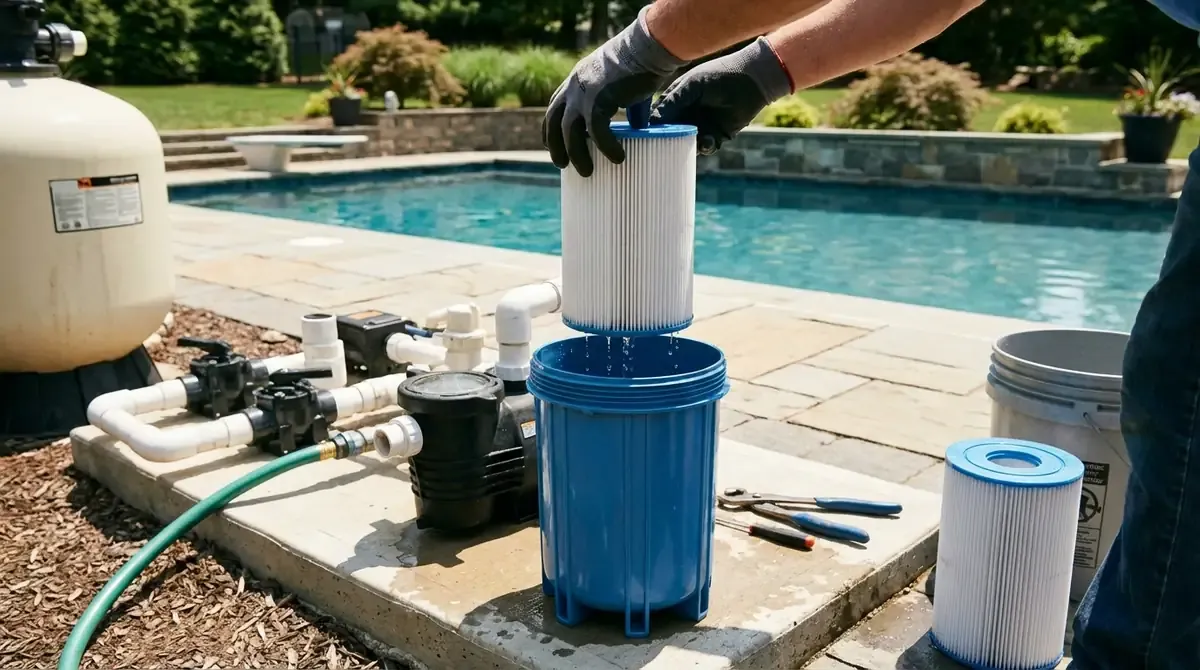
A cartridge filter holds a pleated polyester element inside a sealed housing. Pump water flows through the pleats, which capture debris down to 10-15 microns. To clean it, you remove the cartridge and rinse it with a garden hose, followed by a degreaser soak every 1-3 months.
Filtration quality: Better than sand at a meaningful level during heavy use. 10-15 microns captures fine particles that sand lets through at 20-40 microns.
No backwash: The biggest operational advantage. Sand filters send 250-400 gallons of water down the drain with each backwash cycle. Cartridge filters generate zero water waste.
Maintenance reality:
- Monthly rinse: 15-30 minutes
- Quarterly degreaser soak: overnight (you set it, sleep, rinse in the morning)
- No special plumbing (no backwash port or hose needed)
Long-term cost: Cartridge replacement every 3-7 years costs $30-$200 depending on filter size. We have seen TroubleFreePool’s community consistently report 5-7 years of service life with proper care: regular degreaser soaks, no pressure washing, and rotating two cartridges for complete drying between uses.
For the full cartridge cleaning procedure, see how to clean a cartridge filter.
Limitations:
- You cannot backwash (you must physically remove the cartridge for cleaning)
- A pressure washer will permanently destroy the pleats
- More upfront cost than comparably-sized sand filters
Sand filter: what you are getting
A sand filter contains a tank filled with pool-grade silica sand (20-grade, not playground sand). Water flows through the sand bed, which traps particles 20-40 microns and larger. When pressure rises 8-10 PSI above baseline, you backwash: reverse the flow for 2-3 minutes, which flushes trapped debris to waste.
Filtration quality: Adequate for most residential pools under normal conditions. During heavy use weeks, fine particles (sunscreen residue, fine algae) may pass through at 20-40 microns that a cartridge would capture.
Backwash maintenance: Fastest maintenance of any filter type. Backwash takes 2-3 minutes, followed by a 30-second rinse cycle. No disassembly, no hauling a cartridge around.
Water waste: The most overlooked cost comparison between sand and cartridge pool filters is water usage. A sand filter backwash uses 250-400 gallons of water per cycle. At 12-24 backwashes per season, a sand filter uses 3,000-9,600 gallons of water per year purely for maintenance. At the average US water rate of $0.004 per gallon, that is $12-$38 per year in water cost that cartridge owners do not pay.
Check EPA outdoor water use data: EPA outdoor water use statistics{:target=“_blank”}.
Long-term cost: Sand replacement every 3-7 years costs $20-$150 depending on filter size. The sand cost is comparable to cartridge replacement cost.
Above-ground pool context: Sand filters are the standard equipment for above-ground pools like Intex and Bestway. They pair well with the lower-flow pump systems these pools use, and the upfront price is typically $50-$150 less than a comparable cartridge system.
For detailed above-ground care, see above ground pool maintenance.
Limitations:
- Coarser filtration than cartridge or DE
- Water waste per backwash cycle (meaningful in drought areas)
- Requires backwash port and drainage routing (adds installation complexity)
Annual cost of ownership
| Cost Factor | Cartridge Filter | Sand Filter |
|---|---|---|
| Annual media cost (amortized) | $5-$30/year | $3-$20/year |
| Annual water cost (backwash) | $0 | $12-$38/year |
| Total estimated annual cost | $5-$30/year | $15-$58/year |
The upfront cost difference ($50-$150 more for cartridge) is often recovered within 2-5 years through lower water bills. We find this payback period especially compelling in drought-prone states where water rates are rising.
Sand’s advantage is the purchase price, not the running cost. For a full view of pool ownership expenses, see our pool maintenance cost breakdown.
Which should you choose? Scenario-based recommendation
Choose cartridge if:
- You are in California, Nevada, Arizona, or any water-restricted area
- You have a typical residential inground pool
- You want better filtration quality without going to DE filters
- You have no room for backwash drainage routing (no hose, no drain nearby)
Choose sand if:
- You have an above-ground pool (Intex, Bestway) where sand is the standard fit
- Budget is the primary constraint and cartridge would stretch the budget uncomfortably
- Your pool is large and you value fast backwash maintenance over filtration fineness
- You backwash into a drain or garden area where the water use is not a concern
If you are replacing: Switching from sand to cartridge (or vice versa) requires replumbing the filter connections. Factor in $100-$300 in parts or labor for the conversion. For many pools, staying with the existing filter type makes financial sense unless you have a compelling reason to switch.
See Pentair’s pool filter selection guide{:target=“_blank”} for manufacturer-specific sizing recommendations.
FAQ
Is a cartridge filter better than a sand filter for an above-ground pool?
Sand filters are the standard recommendation for above-ground pools and pair well with Intex and Bestway pump systems. They are generally $50-$150 less expensive upfront and work well with the lower flow rates typical of above-ground setups. Cartridge filters work on above-ground pools but add cost without proportional benefit unless you are in a drought-restricted area where backwash water waste is a real concern.
Can I convert my sand filter to a cartridge filter?
Yes, but it requires replumbing. The filter head connections need to match, and most conversions require new fittings and adapters. Budget $100-$300 for parts if doing it yourself, or $200-$500 with a pool tech. If the existing sand filter is in good working condition, switching purely for filtration quality may not be worth the conversion cost unless you are in a drought area.
Which filter is easier to maintain: cartridge or sand?
Each has a different maintenance profile rather than one being objectively easier. Sand filter backwash takes 5-10 minutes and requires no disassembly. Cartridge cleaning takes 15-30 minutes for a hose rinse and an overnight soak every 1-3 months, but requires removing the cartridge. Neither is particularly difficult once you know the procedure. Frequency is similar (both trigger at 8-10 PSI above baseline).
How long does pool filter sand last vs cartridge?
Both typically last 3-7 years. Sand lasts 3-7 years under normal conditions, though pool professionals often recommend replacement every 5 years due to sand rounding that reduces filtration effectiveness. Cartridges last 3-5 years with basic maintenance (SwimUniversity data) and 5-7 years with proper care including degreaser soaks and full drying between uses (TroubleFreePool data). Proper maintenance extends both types by years.
Does a cartridge filter make pool water cleaner than a sand filter?
Yes, measurably. Cartridge filters operate at 10-15 microns compared to 20-40 microns for sand filters. During normal conditions, both produce clear water. During high-bather-load weeks with significant sunscreen and body oil in the water, cartridge filtration produces visibly cleaner water because it captures the fine particles that sand lets through. The difference is most noticeable in pools with 4+ regular swimmers.